


 Sign in


 FXR BattlesPricing
.png)
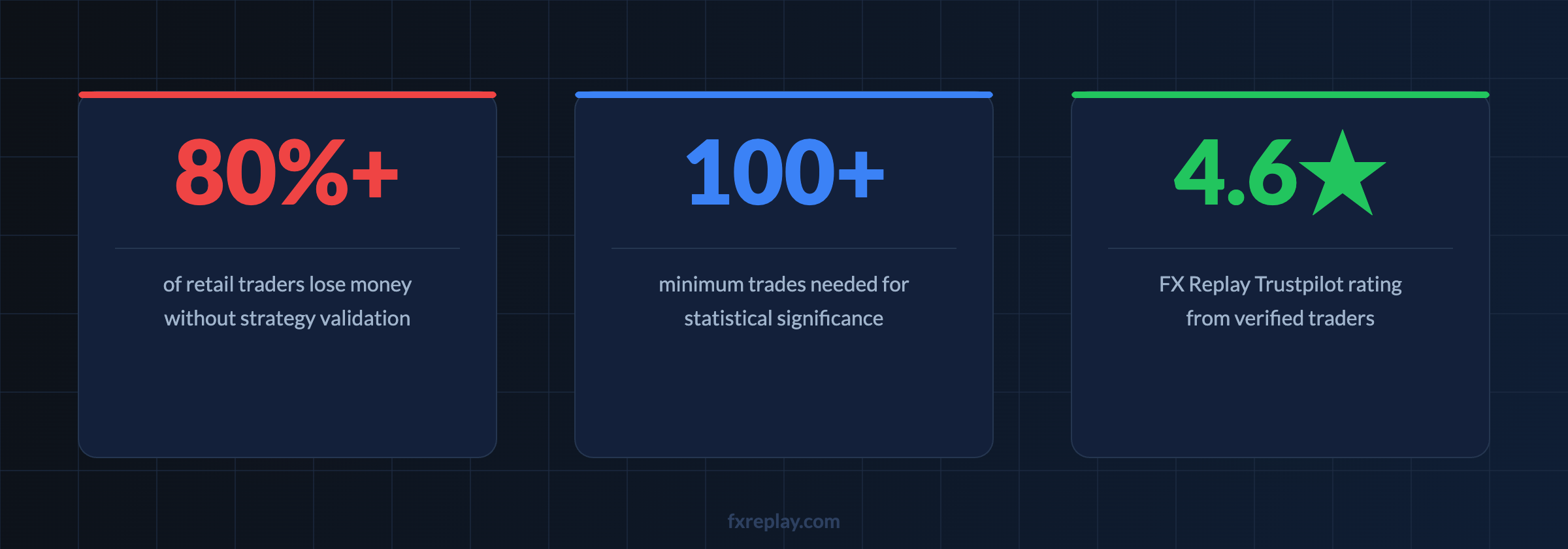
The statistic gets repeated so often it's almost become background noise: over 80% of retail forex traders lose money. Most attribute this to bad luck, poor psychology, or insufficient capital. The real answer is simpler and more fixable; they enter the market with strategies that were never properly tested.
Think about it: would you board a plane if the pilot had never done a single training simulation? Would you trust a surgeon who'd never practiced on a model before operating on a patient? Trading is no different. Without validation, even a technically sound-sounding strategy is just a hypothesis.
"You don't rise to the level of your goals. You fall to the level of your tested habits and tools."
Backtesting is the bridge between a strategy that sounds good and a strategy that is good. It's the missing link most traders never add, and the one that separates consistent performers from chronic account blowers.
Backtesting is the process of applying a trading strategy to historical market data to evaluate how it would have performed. Rather than risking real money to find out if your edge is real, you replay the market as it actually happened, candle by candle, and execute trades based on your rules.
A quality backtesting session tells you:
Key insight: Backtesting isn't just about checking if a strategy was profitable in the past. It's about understanding why it worked, under what conditions, and how it fails, so you know exactly when to trade it live.
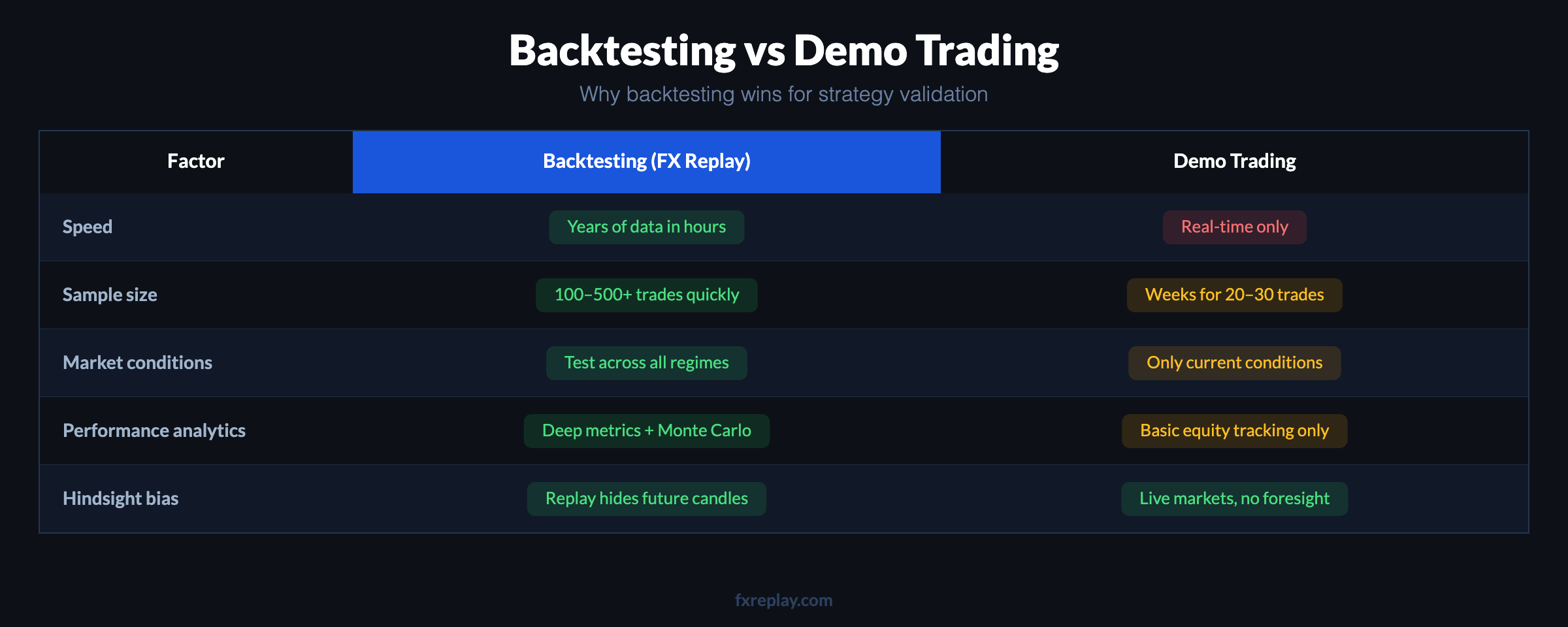
Many traders use demo accounts as their validation tool. While demo trading has value, it's a poor substitute for rigorous backtesting.
Watch: How to use FX Replay in 5 minutes (2026 edition)
Demo trading is excellent for practising execution once you've already validated a strategy. Think of backtesting as the research phase and demo trading as the final dress rehearsal before going live.
A "good-looking" setup on a chart means nothing without data. Backtesting forces you to run your rules across hundreds of scenarios. If your strategy shows a 1.8 profit factor across 200 historical trades, you have evidence, not just intuition, that an edge exists.
Psychology destroys more traders than bad setups. When a drawdown hits during live trading, the trader who backtested 300 trades knows statistically what to expect. The trader who skipped backtesting panics, abandons the system, and locks in losses.
"FX Replay gave me the confidence to go live after six months of consistent testing. It's like training wheels for traders — essential for anyone serious about strategy." — Kris P., verified Trustpilot reviewer
Time-based analytics inside tools like FX Replay reveal exactly which sessions, days of the week, and market conditions produce the best results. This data-driven insight lets you trade more when you win and less when you don't.
Backtesting doesn't just tell you if a strategy works, it tells you how to optimize it. You can test moving your stop loss by 5 pips, adjusting your take-profit ratio, or filtering out low-probability setups. Small tweaks, validated across hundreds of trades, compound into significant performance improvements.
Prop trading firms have strict drawdown limits and profit targets. A strategy that performs well in isolation may breach a 5% daily drawdown rule under stress. Backtesting with platform features that simulate prop firm rules, like those in FX Replay, lets you stress-test your system before your funded challenge begins.
Pro tip: Aim for a minimum of 100 trades in your backtest before drawing conclusions. Fewer trades produce unreliable statistics; a 70% win rate over 10 trades means nothing.
Here's the exact workflow used by professional traders to backtest a strategy from scratch using FX Replay.
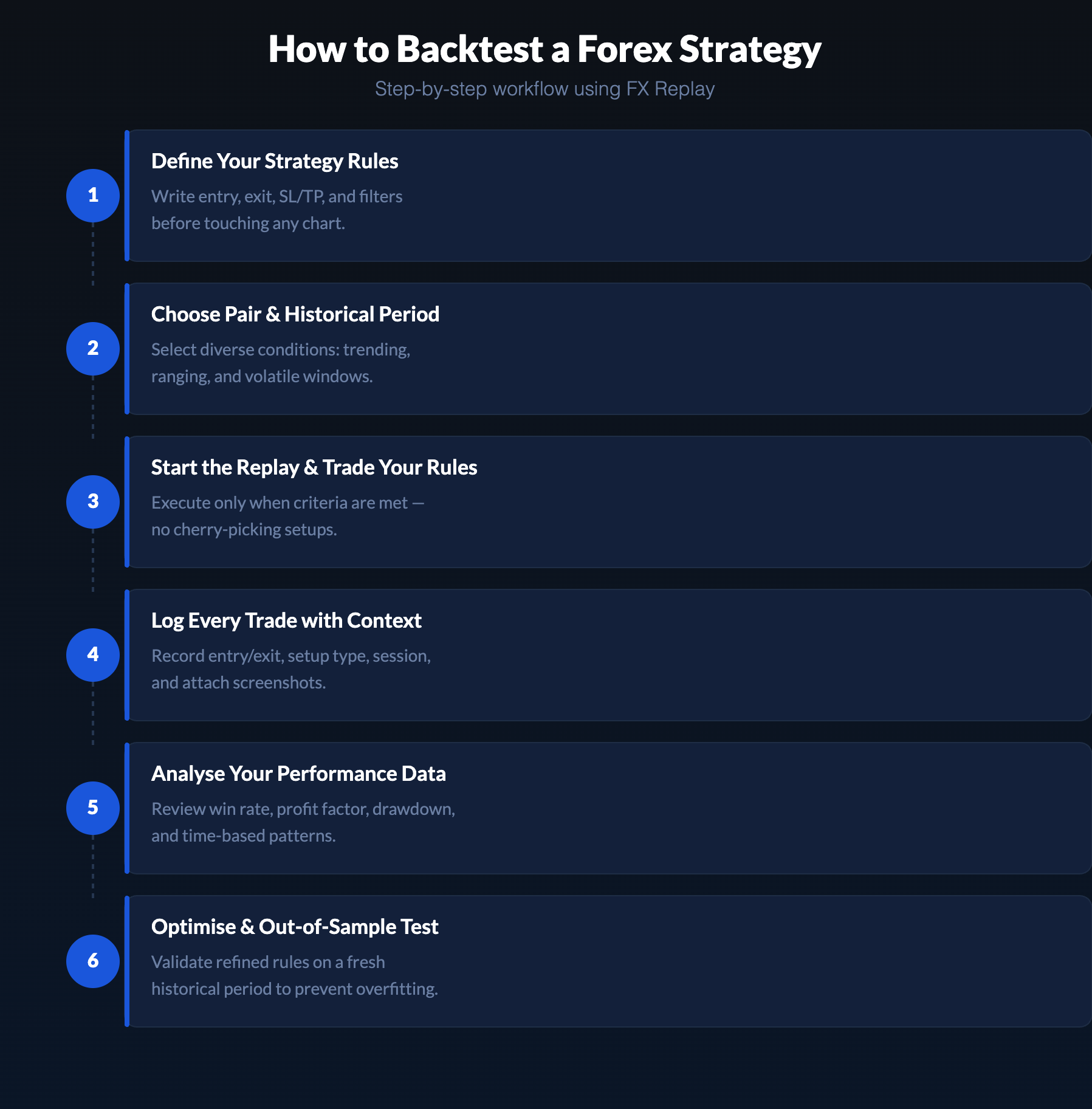
Step 1: Define your strategy rules precisely
Write down your entry conditions, exit rules, stop-loss placement, take-profit targets, and any filters (session time, news avoidance, etc.) before touching the charts.
Step 2: Choose a currency pair and time period
Select your asset (e.g., EUR/USD, GBP/JPY) and a historical window that includes trending, ranging, and volatile conditions. FX Replay's data goes back to 2003 for major pairs.
Step 3: Start the replay and trade your rules
Use replay mode to watch price action unfold. Only enter trades when your defined criteria are met, no cherry-picking. Speed up the replay between setups.
Step 4: Log every trade with context
Record the entry/exit prices, setup type, session, emotional state, and screenshots. FX Replay's built-in journalling tools link each trade directly to the chart.
Step 5: Analyze your performance data
Review your win rate, profit factor, drawdown, and time-based metrics. Look for patterns: which setups win most, which days are consistently losing, where your edge is strongest.
Step 6: Optimize and run out-of-sample validation
Make small rule refinements based on data, then validate on a fresh historical period you haven't tested on; this guards against overfitting your strategy to past data.
Most backtesting solutions are either too simplistic (basic chart replay) or too complex (algorithmic code-based testers). FX Replay was designed from the ground up for manual traders who want realistic, data-rich backtesting with zero coding required.
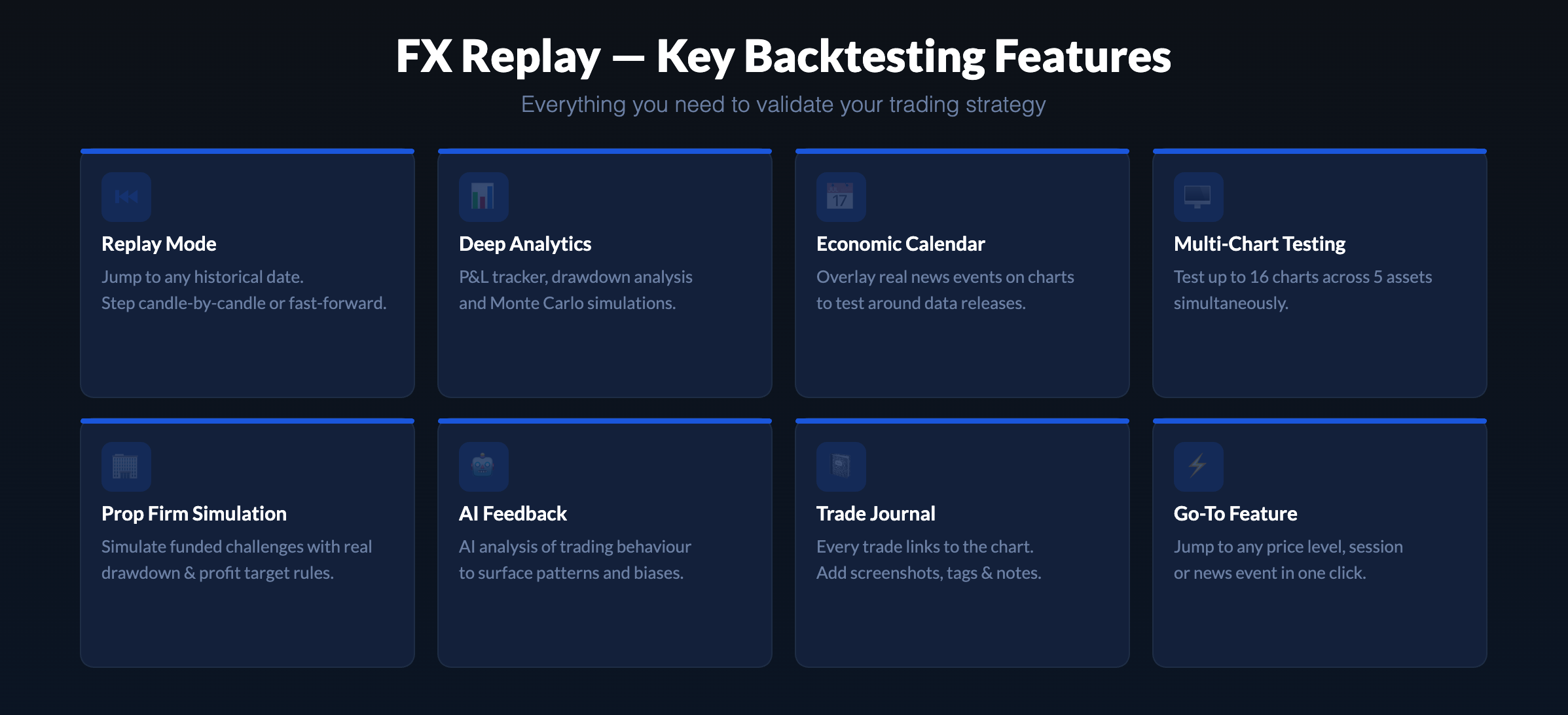
Data quality matters: FX Replay uses institutional-grade tick data sourced from Dukascopy and CME, with history back to 2003 for major forex pairs.
FX Replay integrates TradingView's charting engine, which means zero learning curve if you already use TradingView. It runs entirely in-browser, no downloads required, and supports forex, crypto, futures, indices, and commodities.
Start backtesting free on FX Replay →
Overfitting means your strategy was optimized so precisely for historical data that it no longer generalizes to new market conditions. Signs include suspiciously high win rates (85%+), strategies that only work during a single year, and complex rule sets with many specific filters. The fix: keep rules simple, test on out-of-sample data, and run rolling-window validation.
Testing 15–20 trades and concluding your strategy "works" is a classic error. Small samples are dominated by randomness. A strategy needs a minimum of 100 trades, ideally 200–300, before the statistics become meaningful. FX Replay's Monte Carlo simulation helps you project how your strategy is likely to perform across a range of future scenarios.
The most dangerous form of self-deception in backtesting is unconsciously entering only the setups you can see "worked out." The solution is strict rule adherence: if your entry criteria are met, you take the trade, every time, no exceptions. FX Replay's replay mode enforces this by hiding future candles during playback.
A strategy that works beautifully in trending markets can blow up in ranging conditions. Always test your strategy across bull trends, bear trends, choppy consolidation, and high-volatility events. Deliberately select test periods with different market regimes.
Remember: Backtesting proves historical viability, not future certainty. Always follow backtesting with forward testing in a demo environment before committing real capital.
Couldn't find your question here?
Go check out our Help Center below!
Backtesting is the process of testing a trading strategy against historical market data to evaluate how it would have performed in the past. It allows traders to validate their approach without risking real capital. You "replay" the market as it happened and execute trades according to your defined rules — building a statistical record of your strategy's performance.
Most professional traders recommend logging at least 100 trades during backtesting to achieve statistical reliability. This sample size helps smooth out anomalies and gives you meaningful data on win rate, risk/reward ratio, and maximum drawdown. For higher-confidence results, aim for 200–300 trades across multiple market conditions.
Demo trading is forward-looking. You practise in real time on live (or near-live) markets. Backtesting uses historical data, letting you compress months or years of market activity into hours of focused practice. With backtesting you can test a strategy across hundreds of scenarios far faster than demo trading allows, and you get access to deep performance analytics rather than just a running equity balance.
FX Replay supports over 30 forex pairs (with data back to 2003 for majors), major indices (S&P 500, Nasdaq, DAX, FTSE), cryptocurrencies (Bitcoin, Ethereum, and others), commodities (gold, oil, natural gas), and futures. Some exotic pairs and newer crypto instruments have more limited historical data.
Yes. FX Replay is built on TradingView's charting engine, which millions of traders already use, so the learning curve is minimal. The platform offers a free tier for new users, and the replay controls are intuitive enough to get started in under 10 minutes. Beginners benefit especially from the ability to practise decision-making without financial risk while still building real statistical records of their trades.
.png)
.png)