


 Sign in


 FXR BattlesPricing
Most traders keep a journal but very few actually use it to improve.
Logging trades is only the first step in the journaling process. The real edge comes from turning that data into clear, actionable insights that refine your strategy over time. Start by understanding how turning raw journal data into strategy insights actually works.
In this guide, you’ll learn how to analyze your trading journal the right way, so you can identify what’s working, eliminate costly mistakes, and build a strategy grounded in real performance data.
Whether you’re trading forex, indices, or crypto, this process helps you move from guesswork to consistent, data-driven decision-making.
Before diving into charts and screenshots, start with the numbers.
These metrics tell you whether your strategy is statistically viable.
If your win rate is low but your R:R is high, your strategy may still be profitable, but only if executed consistently.
Not all trades are equal. Break your journal into meaningful categories:
You might discover:
This is where your edge lives.
Look for:
Once identified, double down on these setups.
Your journal will expose recurring errors:
Tag your mistakes in your journal so you can filter them later. Over time, your goal isn’t just better trades, it’s fewer bad habits.
These are also common journaling mistakes that hide your edge without you realizing it.
Data tells you what happened. Replay shows you why.
With FX Replay, you can:
Explore the FX Replay analytics dashboard to see your data in full context.
Your mindset directly impacts performance.
Look for patterns like:
Over time, you’ll see emotional trends that affect your results.
.jpg)
Analysis without action is useless. Create a system that recognizes problems, journal them, and turn insights into rules with better execution. This feedback loop will make it difficult to repeat emotional mistakes and manage risk better.
For example, here are some of the problems vs rules you may encounter that can be solved through this method:
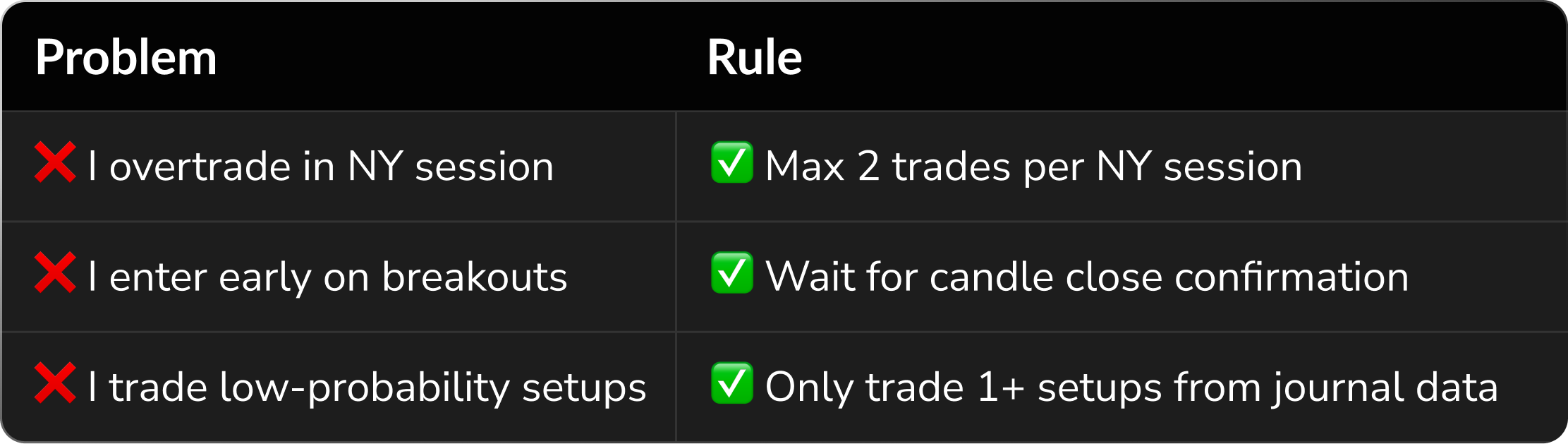
FX Replay’s Live Journal makes this easier to track and tag so you can review your problem areas with precision. Try it here.
The best traders continuously refine their strategy.
This creates compounding improvement over time.
.png)
Avoid these pitfalls:
Your trading journal is one of the most powerful tools you have but only if you use it correctly.
By analyzing your data, identifying patterns, and refining your approach, you move from random results to intentional, data-driven trading.
If you’re not reviewing your trades regularly, you’re leaving progress on the table.
Ready to take your journaling and backtesting to the next level? Use the FX Replay journal to track, analyze, and refine your trades now.
Couldn't find your question here?
Go check out our Help Center below!
You need a meaningful sample size to draw reliable conclusions. Aim for at least 30–50 trades per setup or strategy before making adjustments. Anything less can lead to misleading insights.
There’s no single “best” metric, but expectancy is the most complete. It combines your win rate and risk-to-reward ratio to show whether your strategy is profitable over time.
This usually comes down to execution or psychology, not strategy.
Check for:
Your journal notes and replay analysis are key here.
Your A+ setups are the ones that consistently show:
These are the setups you should prioritize and scale.
Treating journaling as a passive activity. If you’re only logging trades but not analyzing patterns and adjusting your rules, you’re not improving—you’re just recording history.
.png)
.png)