


 Sign in


 FXR BattlesPricing
.png)
Most traders believe success comes from finding the perfect indicator or entry setup. In reality, long-term profitability often comes from understanding your own trading behavior.
Your trading journal holds the answers.
Every trade you take creates valuable data entry timing, risk management, market conditions, emotions, and execution quality. When analyzed correctly, this data reveals the patterns behind your winning and losing strategies.
Professional traders rely heavily on performance analytics because numbers remove emotional bias. A detailed trading journal can expose hidden habits that either improve or destroy profitability.
In this guide, we’ll break down how traders can use journal data to uncover winning patterns, eliminate costly mistakes, and continuously improve performance using tools like FX Replay.
A trading journal is more than a trade log. It’s a performance optimization tool.
Without measurable data, traders rely on memory and emotion; both unreliable sources for decision-making.
A high-quality journal helps traders:
The difference between consistently profitable traders and struggling traders often comes down to one thing:
Data-driven improvement.
Many traders think they know their best strategy, until the data proves otherwise.
By analyzing your journal, you can identify:
For example, your data may reveal:
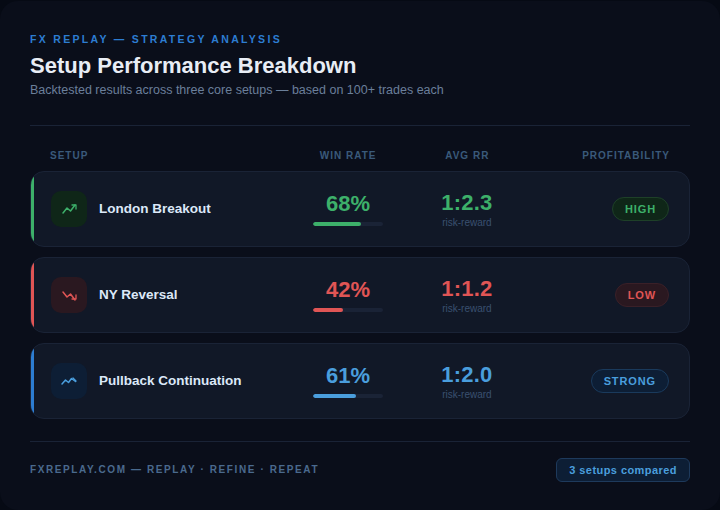
These insights allow traders to focus only on high-performing strategies instead of wasting time on weak setups.
Your journal also exposes destructive patterns many traders overlook.
Common losing habits include:
The problem is that these habits are hard to recognize in real time. Journal analytics make them impossible to ignore.
For instance, your data might reveal:
This transforms vague feelings into actionable insights.
Professional traders treat trading like a business. That means tracking performance metrics such as:
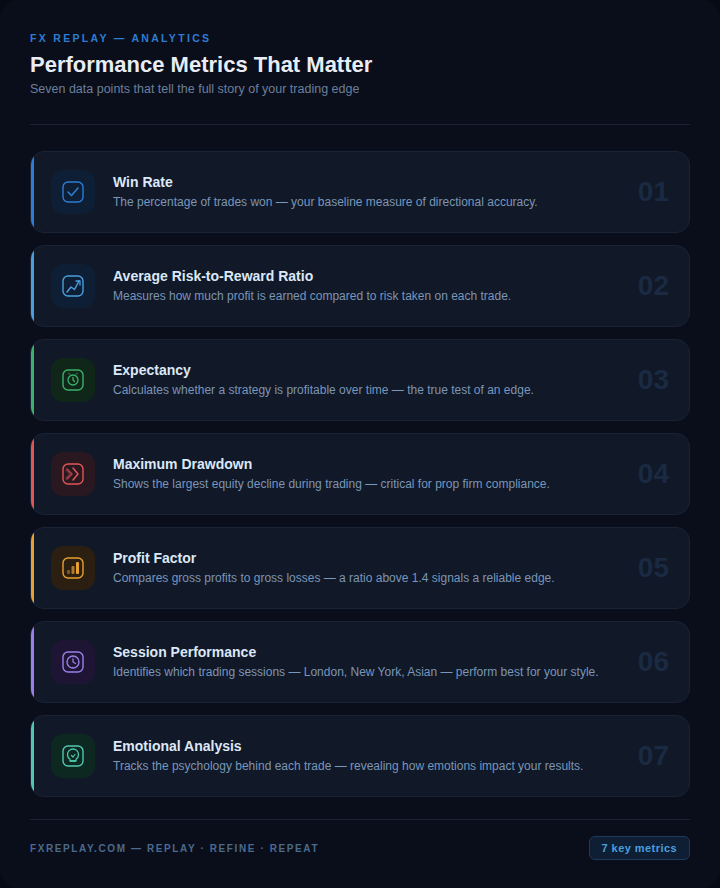
One of the fastest ways to improve trading performance is combining journaling with backtesting.
Backtesting allows traders to test strategies against historical market data before risking real money.
Using a platform like FX Replay, traders can:
This creates a powerful feedback loop:
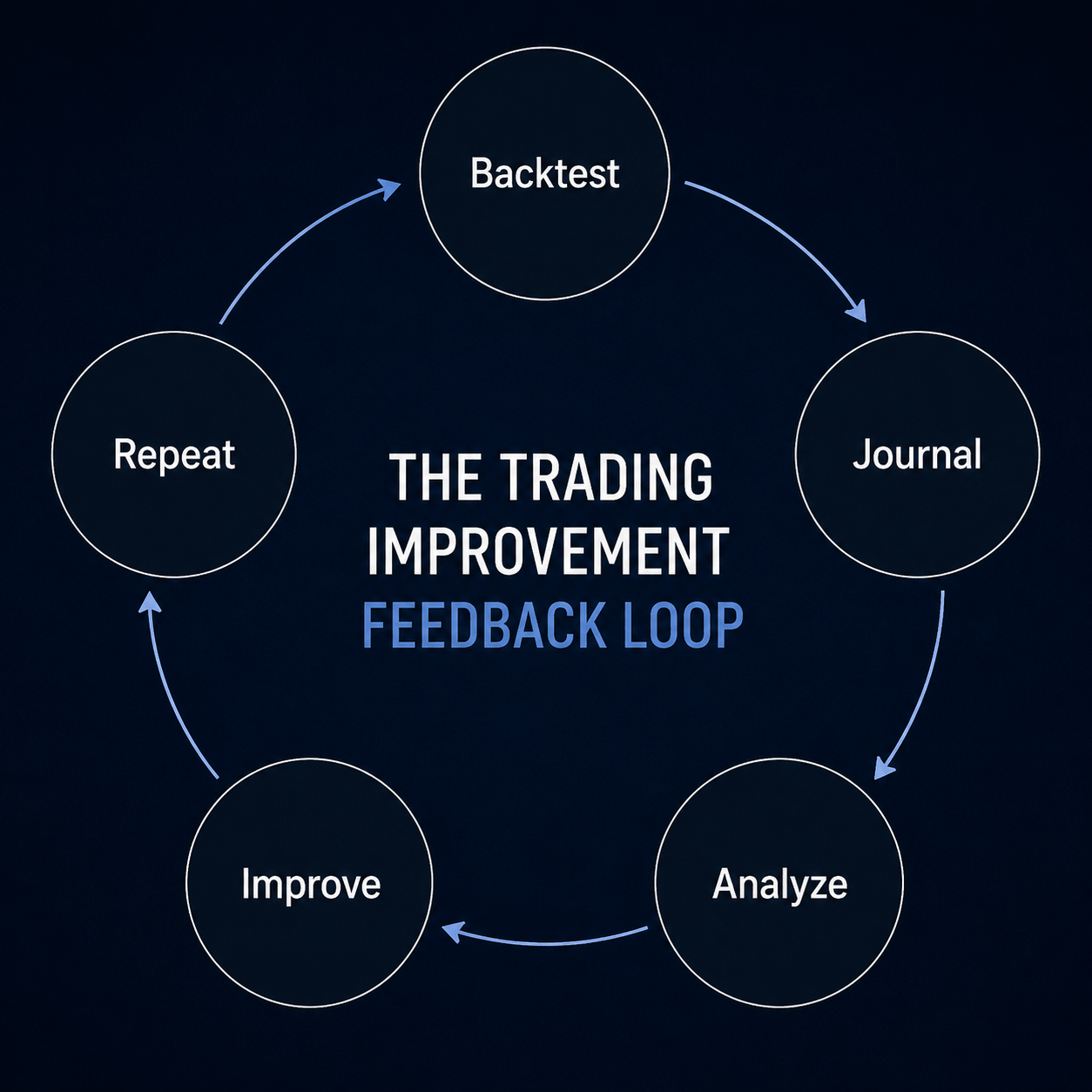
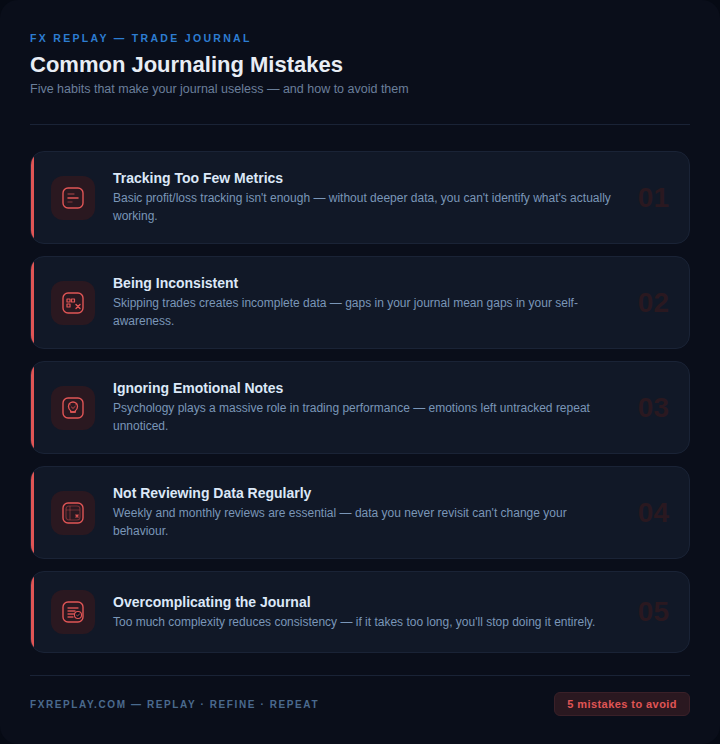
Many traders keep journals but never actually analyze the data. They simply record entries and exits without extracting meaningful insights.
A proper trading journal should answer questions like:
Without analysis, journaling becomes useless documentation instead of a growth tool.
Here are the most important metrics to include in your journal:
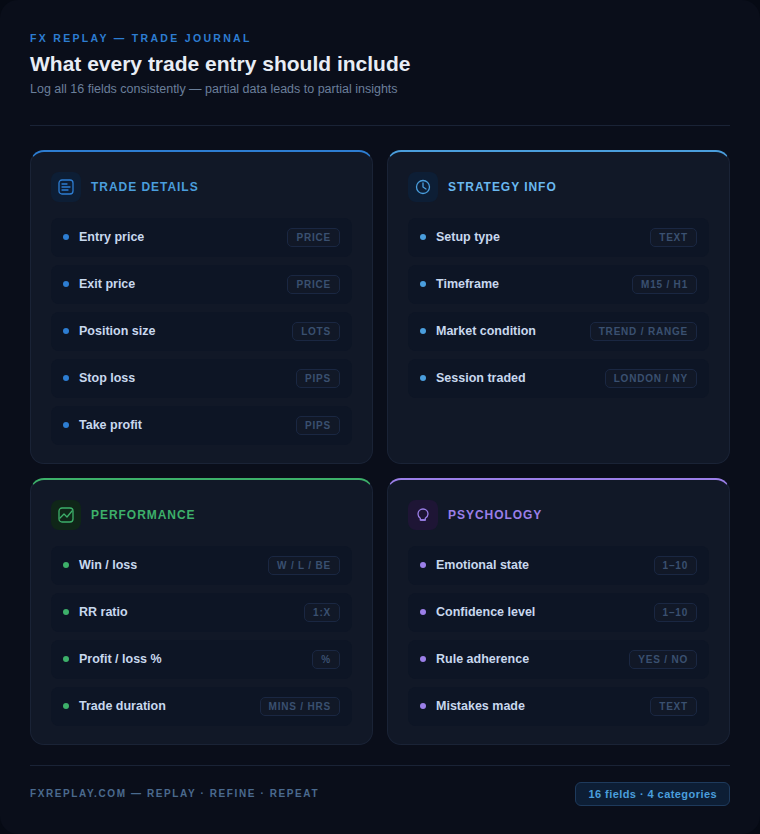
FX Replay is designed to help traders accelerate learning through replay trading and strategy analysis. Instead of waiting weeks for live setups, traders can practice and collect performance data rapidly.
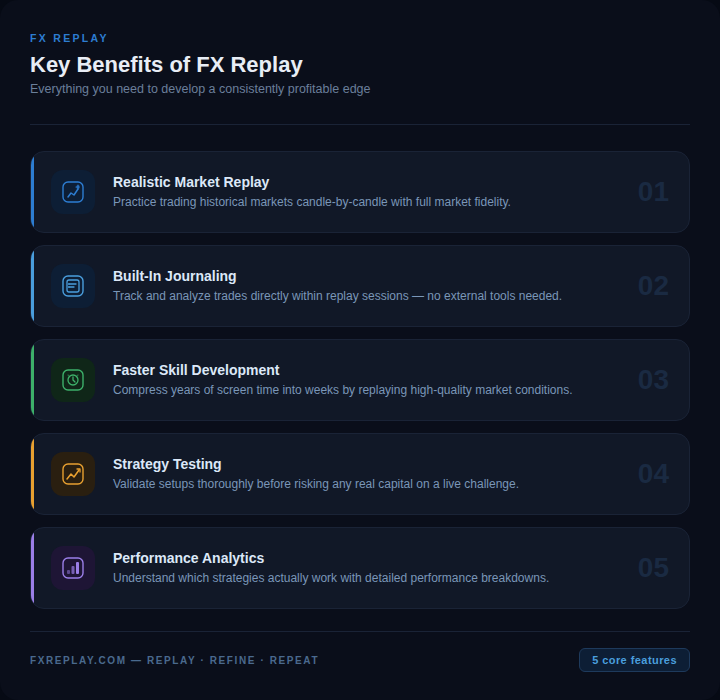
For traders serious about consistency, combining replay trading with journal analysis can dramatically shorten the learning curve.
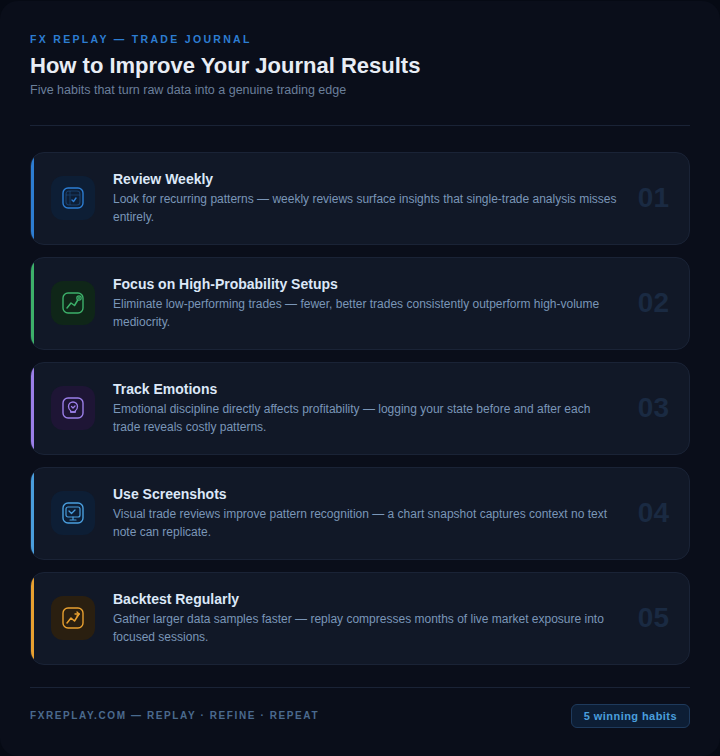
Your trading journal contains the blueprint for improvement. Winning traders aren’t necessarily smarter, they simply use data more effectively.
By analyzing journal data consistently, traders can:
The combination of journaling and backtesting creates one of the fastest paths to trading improvement.
If you want to accelerate your learning curve, start combining detailed trade analysis with realistic replay trading using FX Replay.
Couldn't find your question here?
Go check out our Help Center below!
A trading journal is a detailed record of your trades, including entries, exits, risk management, emotions, and strategy notes used to analyze trading performance.
A trading journal helps traders identify profitable patterns, eliminate mistakes, and improve consistency through data-driven analysis.
Most professional traders review journal data weekly and monthly to identify recurring patterns and performance trends.
Yes. Consistent journal analysis helps traders refine strategies, improve discipline, and avoid repeated mistakes.
.png)
.png)