


 Sign in


 FXR BattlesPricing
.png)
Most traders think journaling is enough.
It isn't.
A journal only becomes useful when it helps you make better decisions. Simply recording trades does not improve performance.
Many traders log hundreds of trades, yet continue making the same mistakes every week because they never turn their journal into a decision-making tool.
Most journals are built like diaries. They record what happened:
Improvement does not come from documentation alone. It comes from consistent analysis, rigorous testing, and continuous adjustment.
Most traders already have enough data to improve. The real issue is not the lack of information, but the lack of a structured process.
A typical journal entry looks like this:
EUR/USD breakout trade. Entered at 1.0710, exited at 1.0730. +$200. The market was trending. I felt confident.
The problem is that this tells you what happened, but not why it happened.
A better review asks deeper questions:
That is the difference between simply recording trades and actually studying them. The traders who improve are not necessarily the ones writing more. They are the ones asking better questions.
Strong traders use their journal as a strategy optimization environment where every trade helps refine execution, risk management, and market selection.
They:
Over time, their journal becomes a structured system for optimizing entries, exits, sizing, execution quality, and market selection.
This is where real strategy improvement and long-term consistency come from.
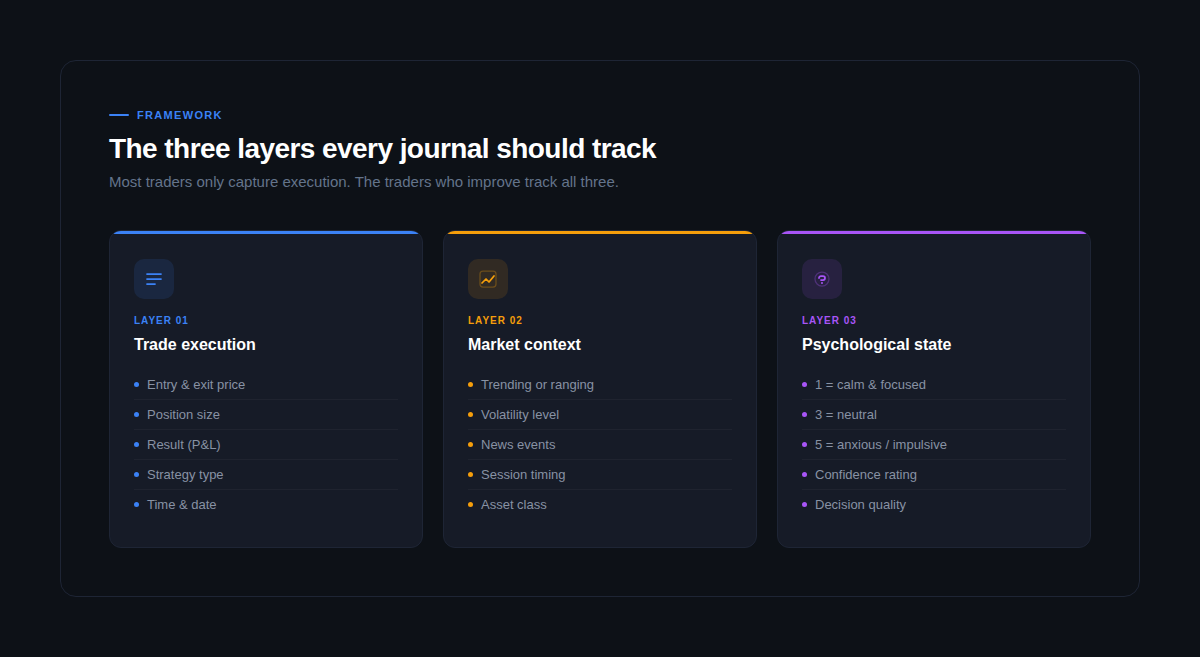
Most traders only track one layer: execution. That is not enough. A useful journal should capture three types of information.
These are the mechanical details:
This creates a baseline record of what actually happened. Without this layer, there is nothing meaningful to review later. However, on its own, it still does not tell you whether your trading approach has a repeatable edge.
The same strategy behaves differently under different market conditions.
A breakout strategy may perform very well in strong trends and fail repeatedly in ranging markets. That context matters.
Track conditions such as:
Without market context, you end up comparing trades that should never be compared.
This is where many traders uncover the real source of their inconsistency.
There is no need to write emotional essays after every trade. Keep the review process simple, objective, and measurable.
Example:
Over time, patterns appear:
This information becomes extremely valuable because it helps you understand when your decision-making is strongest and when it breaks down.
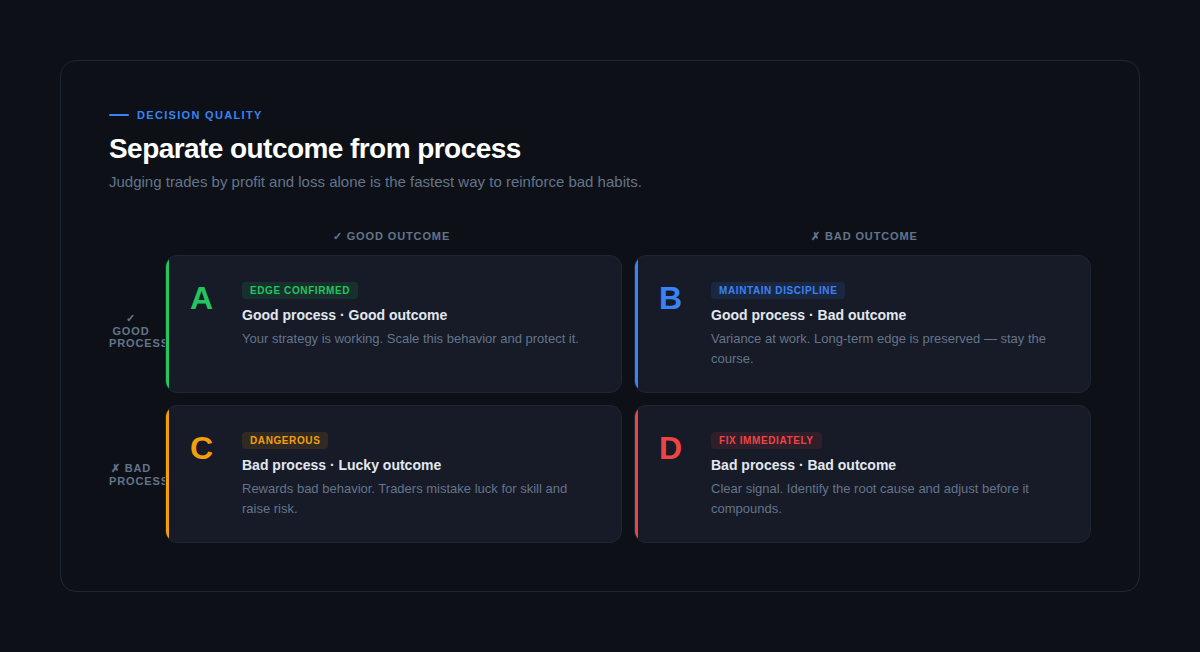
One of the biggest mistakes traders make is judging trades purely by profit or loss.
A profitable trade can still be poorly executed. A losing trade can still be the correct trade.
That distinction matters because strong processes compound over time, while lucky outcomes often create false confidence and reinforce bad habits.
A useful journal grades decision quality separately from results.
For example:
Your long-term edge is usually found in A and B trades.
C trades are dangerous because they reward bad behavior. Traders often mistake lucky wins for skill and slowly increase risk around weak decisions. That eventually becomes expensive.
Many traders build overly complicated journals and abandon them after two weeks.
The goal is not perfection. The goal is consistency.
A practical journal usually includes:
The "Next Action" section is important.
Every trade should end with one lesson or adjustment:
This converts observation into behavioral change. Without that step, journaling becomes passive.
Most traders only review trades emotionally:
That creates inconsistent learning.
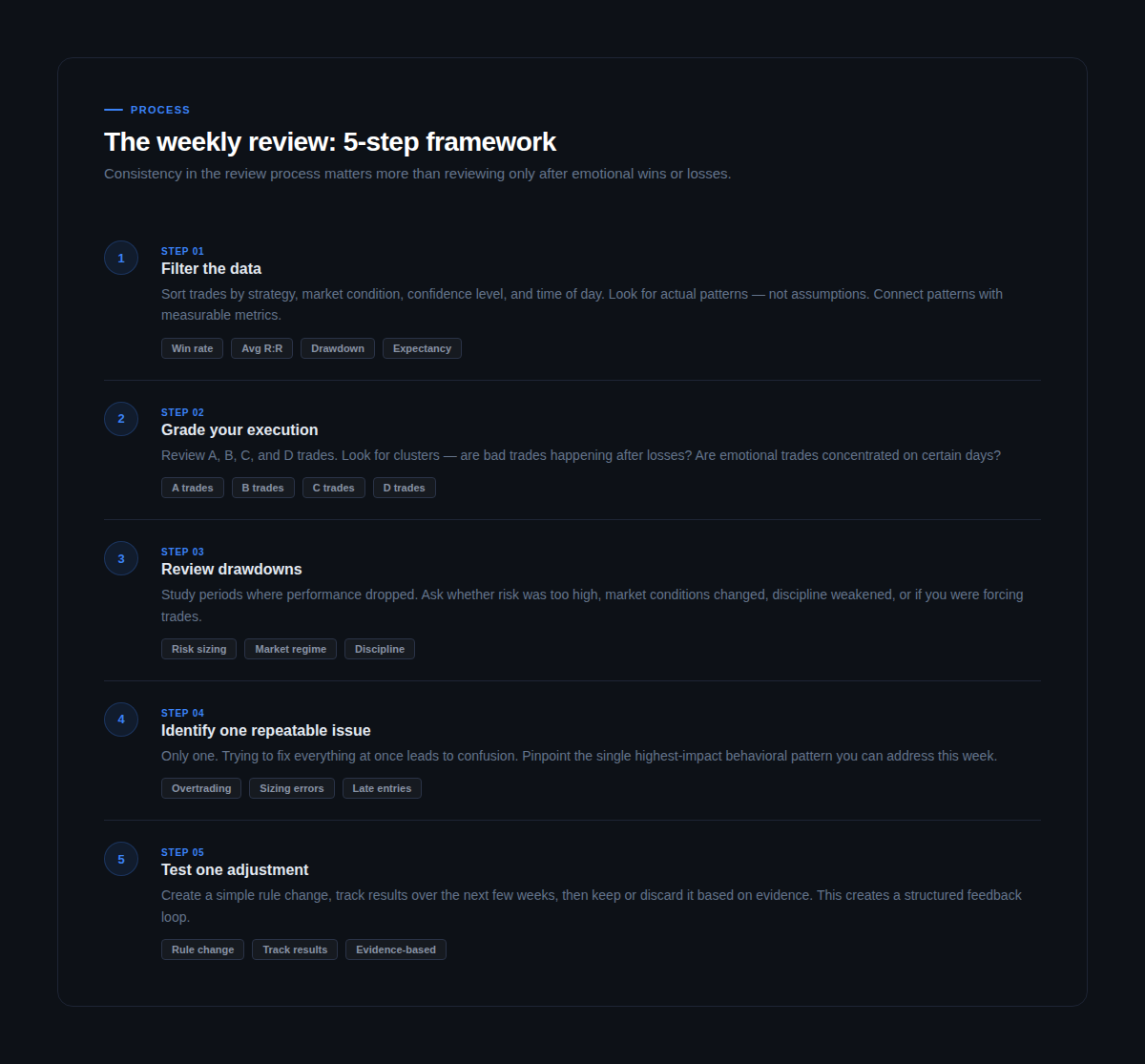
A better approach is to review your trades at the same time every week, regardless of whether the results were good or bad. Consistency in the review process matters more than reviewing only after emotional wins or losses.
The review itself does not need to be complicated. A strong review process does more than just identify mistakes. It helps traders optimize specific parts of their strategy over time: better entry timing, cleaner exits, improved position sizing, stronger market selection, and better risk-to-reward management.
Sort trades by:
Look for actual patterns instead of assumptions.
The goal is to connect patterns with measurable strategy performance metrics such as win rate, average risk-to-reward, drawdown, expectancy, and performance by market condition.
This helps traders make evidence-based adjustments instead of emotional decisions.
You may discover:
Most traders never see these patterns because they never organise the data properly.
Review your A, B, C, and D trades.
Look for clusters:
This reveals behavioral leaks very quickly.
Study periods where performance dropped. Ask:
Only one.
Examples
Trying to fix everything at once usually leads to confusion.
Create a simple rule change. Examples:
Then track the results over the next few weeks. This creates a structured feedback loop.
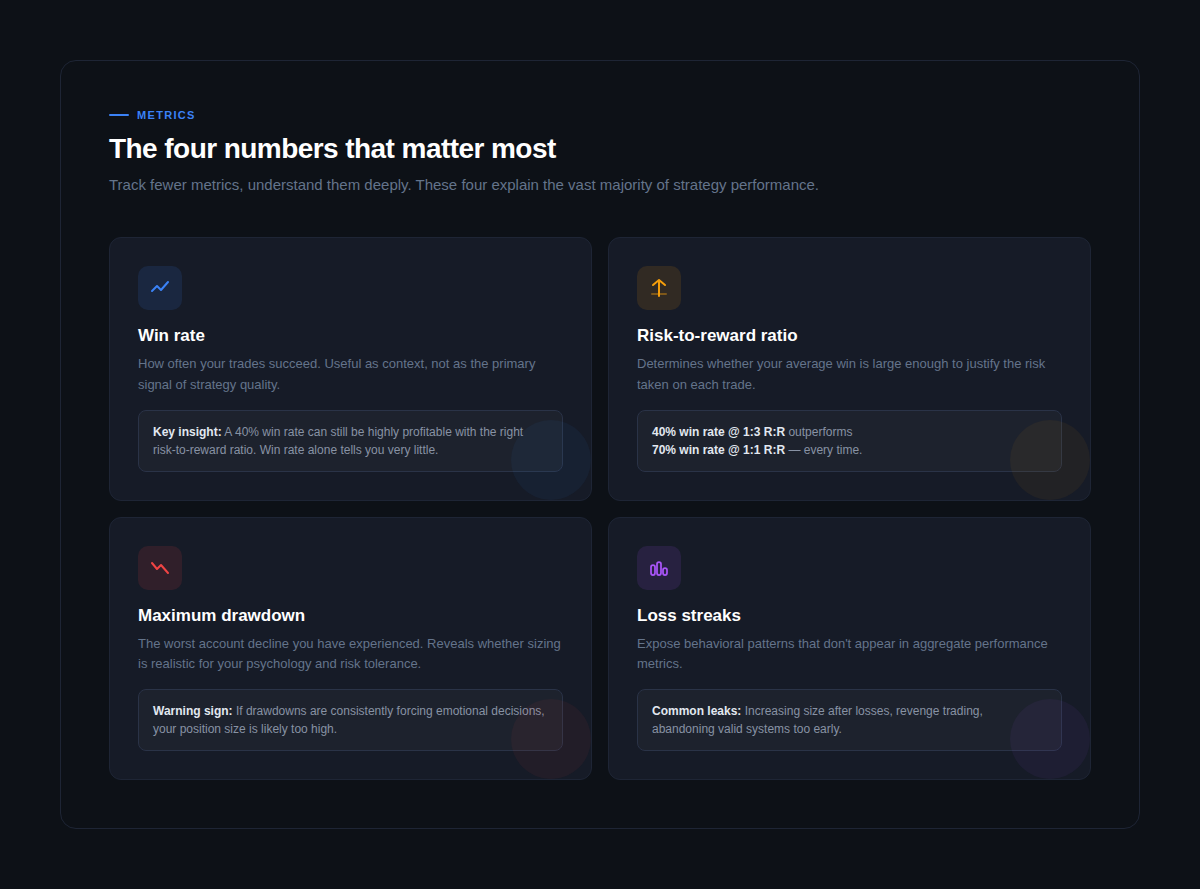
Many traders track too many metrics. Four numbers explain most of what matters:
This tells you how often your trades are successful. However, win rate alone provides very little context.
A strategy with a 40% win rate can still be highly profitable if the average winning trade is significantly larger than the average losing trade.
This determines whether your average win is large enough to cover losses.
A trader with:
can outperform a trader with:
This is why risk management matters more than being correct all the time.
This shows the worst decline your account has experienced.
It reveals whether your sizing is realistic for your psychology and risk tolerance. If your drawdowns constantly force emotional decisions, your risk is likely too high.
Losing streaks expose behavioral problems. Many traders:
Tracking streaks helps you identify those patterns before they become destructive.
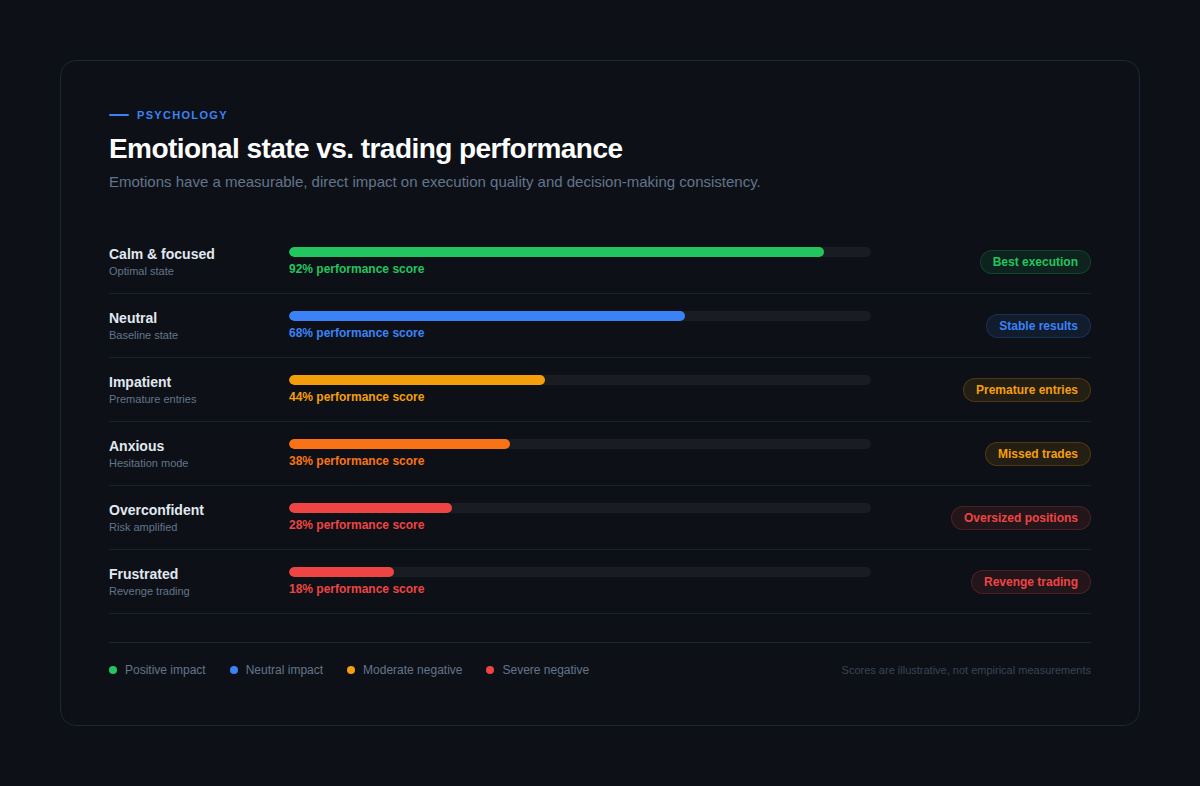
Many traders avoid tracking psychology because they want trading to feel purely technical and objective.
However, emotions have a direct impact on execution quality, decision-making, and overall consistency.
Your journal will often reveal clear emotional patterns in execution:
This is not abstract psychology. It is measurable behavior directly tied to trading performance.
The goal is not to eliminate emotions entirely. The goal is to understand how emotions influence decision-making, execution, and consistency.
Once these patterns become visible, you can start making practical adjustments:
Most traders separate journaling and backtesting. They should not.
Your journal contains real execution data:
That makes it extremely valuable. You can filter your journal and test ideas such as:
If a rule adjustment improves performance over a meaningful sample size, you now have evidence supporting that change.
This is how skilled traders refine their systems over time — not through random strategy hopping, but through structured testing, review, and iteration.
The process is simple:
That cycle, repeated consistently over months, can completely transform a trader's performance.
Most traders spend their time endlessly searching for better indicators. Better traders focus on improving the quality of their decisions.
Over time, small refinements compound:
This is how professional traders evolve. Not through shortcuts, but through structured feedback.
Most strategy optimization does not come from discovering new indicators. It comes from refining execution using data from your existing trades.
Most traders already have enough data. What they lack is proper extraction and analysis.
The patterns behind your best trades, biggest mistakes, strongest market conditions, and emotional weaknesses are often already hidden inside your trading records.
The difference between stagnant traders and improving traders is the presence of a structured process.
A good trading journal is not about writing more. It is about systematically improving your strategy through consistent review, measurable adjustments, and evidence-based decision-making.
Most traders already have the data they need to improve. The real problem is that they never organise, review, or test it properly.
A trading journal should do more than simply record entries and exits. It should help you understand:
That is what transforms journaling from simple record-keeping into true strategy optimization.
The traders who improve consistently are usually not making dramatic changes every week. They are making small, evidence-based adjustments backed by their own data and review process.
Couldn't find your question here?
Go check out our Help Center below!
A trading journal is a structured record of your trades, decisions, market conditions, and psychological state. It is important because it transforms raw trading activity into actionable insights, helping traders identify patterns, eliminate recurring mistakes, and improve decision quality over time rather than relying on memory or intuition alone.
A complete trading journal should include: entry and exit prices, position size, strategy or setup type, market conditions, trade outcome, emotional state during execution, decision quality grade, and a key lesson or next action. Tracking both technical and psychological data gives the most complete picture of performance.
A journal helps traders identify which setups, market conditions, and execution behaviors produce the best results. By filtering real trade data and testing one rule adjustment at a time, traders can refine entries, exits, position sizing, and risk management using evidence, not assumptions.
A structured weekly review works best for most traders. Reviewing at the same time each week, regardless of recent results, creates consistent learning and prevents emotionally-driven analysis that only happens after big losses or strong winning streaks.
Yes. Emotional states directly influence execution quality and risk decisions. Tracking a simple confidence or emotional state score (e.g., 1–5) over time reveals clear patterns: which emotional states correlate with better or worse performance, and what conditions trigger impulsive or fearful decisions.
.png)
.png)