


 Sign in


 FXR BattlesPricing
.png)
If you’re serious about becoming a profitable trader, backtesting forex strategies isn’t optional, it’s essential.
Too many traders jump into live markets with unproven systems, only to discover (the hard way) that their “edge” doesn’t actually exist. Backtesting helps you answer the most important question in trading:
Does my strategy actually work over time?
In this guide, you’ll learn how to properly backtest your forex strategies, validate your edge, and build the confidence you need before risking real capital. Start with the top forex backtesting tools compared to find the right platform for your process.
Backtesting is the process of testing a trading strategy using historical market data to see how it would have performed in the past.
Instead of guessing or relying on intuition, you’re using data to evaluate:
When done correctly, backtesting transforms trading from gambling into a data-driven process.
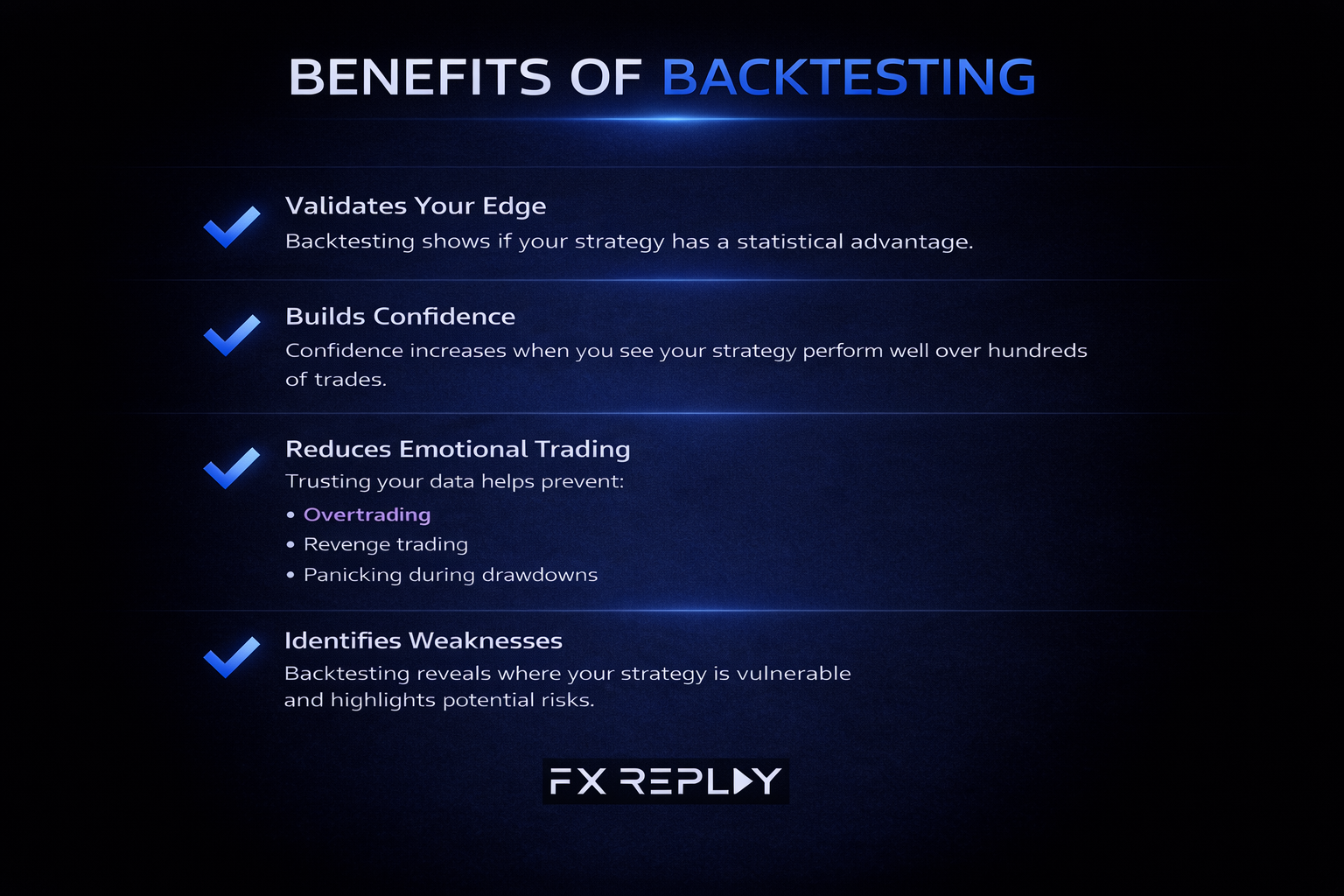
Skipping backtesting is like flying blind. Here’s why it matters:
Backtesting confirms whether your strategy has a statistical advantage.
Knowing your system has worked across hundreds of trades makes it easier to stick to your plan.
When you trust your data, you’re less likely to:
Backtesting reveals:
A strategy isn’t valid just because it made money once.
A validated trading edge typically includes:
Before testing anything, your rules must be crystal clear:
If your rules are vague, your results will be unreliable.
Focus on:
Consistency is key—don’t mix variables during testing.
Use high-quality chart data to simulate past conditions.
The more accurate your data:
This is where tools like FX Replay shine.
Instead of scrolling static charts, you can:
This creates a true simulation of live trading conditions.
Track everything in a journal:
Your journal is where the real insights come from.
After enough trades, calculate:
This is where you determine if your strategy actually has an edge.
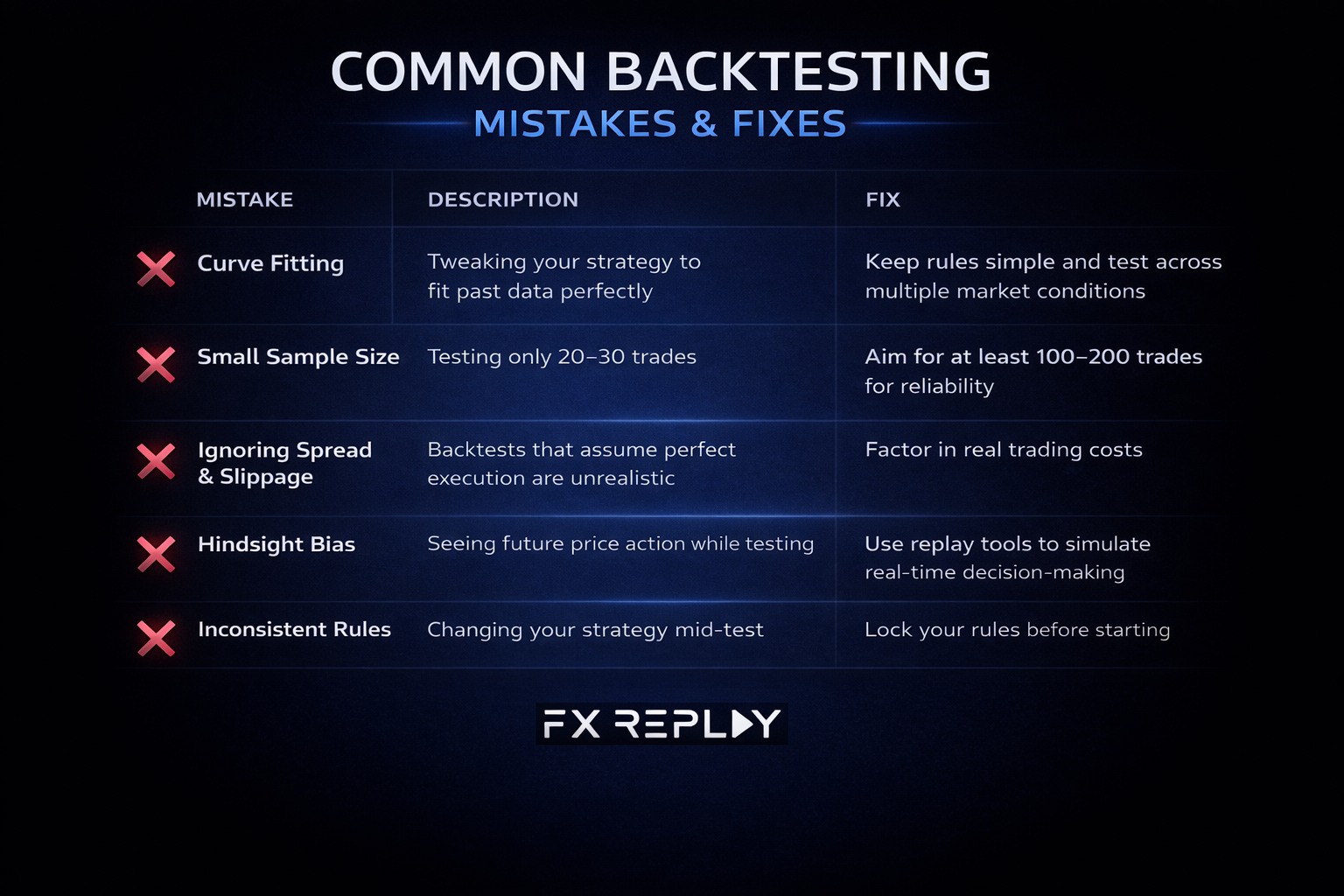
Tweaking your strategy to fit past data perfectly.
Fix: Keep rules simple and test across multiple market conditions.
Testing only 20–30 trades.
Fix: Aim for at least 100–200 trades for reliability.
Backtests that assume perfect execution are unrealistic.
Fix: Factor in real trading costs.
Seeing future price action while testing.
Fix: Use replay tools to simulate real-time decision-making.
These are also the common pitfalls in forex backtesting worth knowing before you start.
Changing your strategy mid-test.
Fix: Lock your rules before starting.
Best for discretionary traders
Pros:
Cons:
Best for algorithmic strategies
Pros:
Cons:
FX Replay is designed to make backtesting:
With features like:
You can validate your strategy in a live-like environment without risking real money.
You’re ready to transition when:
Even then, start small.
Backtesting isn’t just a step, it’s the foundation of profitable trading.
If you want to succeed in forex, you need more than a strategy; you need proof that it works.
Take the time to:
Because in trading, confidence doesn’t come from hope, it comes from data.
Start backtesting your forex strategies today with FX Replay and experience the difference of trading with real data, not guesswork.
Your edge is waiting; you just need to prove it.
Couldn't find your question here?
Go check out our Help Center below!
The best way is to use manual backtesting with replay tools so you can simulate real market conditions. This helps eliminate hindsight bias and improves decision-making skills while validating your strategy.
A minimum of 100–200 trades is recommended. This provides a statistically meaningful sample size to determine whether your strategy has a real edge.
Yes but only if done correctly. Reliable backtesting requires:
Poor backtesting leads to misleading results.
A “good” win rate depends on your risk-to-reward ratio.
For example:
What matters most is overall expectancy, not just win rate.
Absolutely. Backtesting helps beginners:
It’s one of the fastest ways to improve as a trader.
.png)
.png)