


 Sign in


 FXR BattlesPricing
.png)
If you've ever blown a prop firm challenge on day 12 after a clean 11-day run, you already know the problem: it wasn't the market that beat you, it was yourself. Emotional entries, revenge trades, oversizing after a winner, these are consistency killers, and prop firms are specifically designed to expose them.
The traders who consistently pass challenges and grow funded accounts to six figures aren't necessarily the most talented. They're the most prepared. And preparation, at the highest level, means systematic backtesting, not just running a strategy on historical data, but replaying the market to stress-test your own decision-making under realistic conditions. The structured backtesting approach behind prop firm success is what this guide is built around.
In this guide, we break down exactly how top prop firm traders use backtesting to build the consistency that separates funded traders from those stuck paying challenge fees.
Prop firms like FTMO, MyFundedFX, and The Funded Trader don't just test whether you can make money. They test whether you can make money without blowing up. Most challenges include daily drawdown limits (typically 5%) and maximum overall drawdown (8–10%). The consistency rule, often requiring no single trading day to account for more than a set percentage of total profits, adds another layer.

The underlying cause of most failures isn't bad strategy, it's behavioral inconsistency. A trader takes a valid setup, wins big, gets overconfident, sizes up, takes a marginal setup, and loses it all in one session. Backtesting doesn't just validate your strategy, when done properly with market replay, it trains your behavior.
"Backtesting told me my strategy had a 61% win rate. Market replay showed me I was only executing it with discipline 61% of the time, the rest was emotion. That gap cost me two challenge fees before I fixed it." — Anonymous funded trader, FTMO $200k account
Backtesting is the process of applying your trading strategy to historical market data to see how it would have performed. In its simplest form, you scroll back through charts and mark every valid setup. In its most powerful form, market replay backtesting, you simulate trading in real time, making decisions bar by bar without knowing what comes next.

There are two main types of backtesting relevant to prop traders:
1. Manual chart backtesting
You scroll through historical data, identify setups based on your rules, and log results in a spreadsheet. Fast and simple, but lacks the psychological pressure of real execution.
2. Market replay backtesting
You replay the market in real time, placing entries and exits as if you were live trading. This is the gold standard for prop firm prep because it replicates the emotional context of decision-making, the uncertainty, the FOMO, the hesitation.
💡 Pro tip: Market replay is the closest simulation to a live prop firm challenge without paying challenge fees. Serious funded traders treat each replay session as a challenge attempt, same rules, same discipline, same risk management.
Successful prop firm traders don't just randomly click through old charts. They follow a systematic process designed to surface both strategy flaws and execution gaps. Here's the framework used by consistently funded traders:

Step 1: Define your strategy rules precisely
Before touching a replay tool, write out every rule with zero ambiguity. Entry criteria, stop loss placement, take profit targets, session times, news avoidance windows, and maximum daily trades. Vague rules are unbacktestable strategies. If you can't define it, you can't test it, and you can't execute it consistently in a funded account.
Step 2: Set challenge-mirroring parameters
Configure your backtesting environment to match your target prop firm's rules exactly. Apply the daily drawdown limit, overall drawdown cap, and profit target to your replay session. Tools like FX Replay allow you to set these parameters so every replay session feels like the real thing.
Step 3: Execute the replay without skipping forward
This is where most traders cheat, and where the value is lost. Trade bar by bar, in real time. Don't skip ahead to see if a setup worked. Record your reasoning for every trade. Treat missed setups (no-trade decisions) as equally important data points as executed ones.
Step 4: Review and tag every trade
After each session, review all trades and categorize them: A-grade setups (fully rule-compliant), B-grade (minor deviations), and C-grade (impulsive/emotional). Track your execution rate on A-grade setups specifically. If your strategy has a 60% win rate but you only take A-grade setups 70% of the time, your real-world win rate degrades accordingly.
Step 5: Build a statistical edge profile
After 100+ trades, calculate win rate, average R:R, expectancy, maximum consecutive losses, and drawdown profile. This data becomes your psychological anchor during a live challenge — when you hit 3 losses in a row, your backtesting data tells you that's well within your strategy's normal distribution.
Tracking the right metrics is what separates useful backtesting from busywork. These are the numbers prop traders monitor most closely:

📊 Important: Always backtest across a minimum of 100 trades before drawing conclusions. Small sample sizes produce unreliable statistics. The more trades in your sample, the more confident you can be that your edge is real, not just luck.
A proper backtesting setup mirrors the conditions of a live prop firm challenge, same instruments, same timeframes, same rules. Not all backtesting tools are equal. Here's how the main options compare for prop firm prep:

FX Replay is purpose-built for manual traders who want to simulate prop firm conditions. With tick-accurate replay data, built-in journaling, and the ability to set challenge parameters including drawdown limits and profit targets, it's the closest thing to a prop firm simulator available, without the challenge fee.
🔗 Related: How to Use Market Replay Effectively — a step-by-step guide to setting up your first replay session in FX Replay.
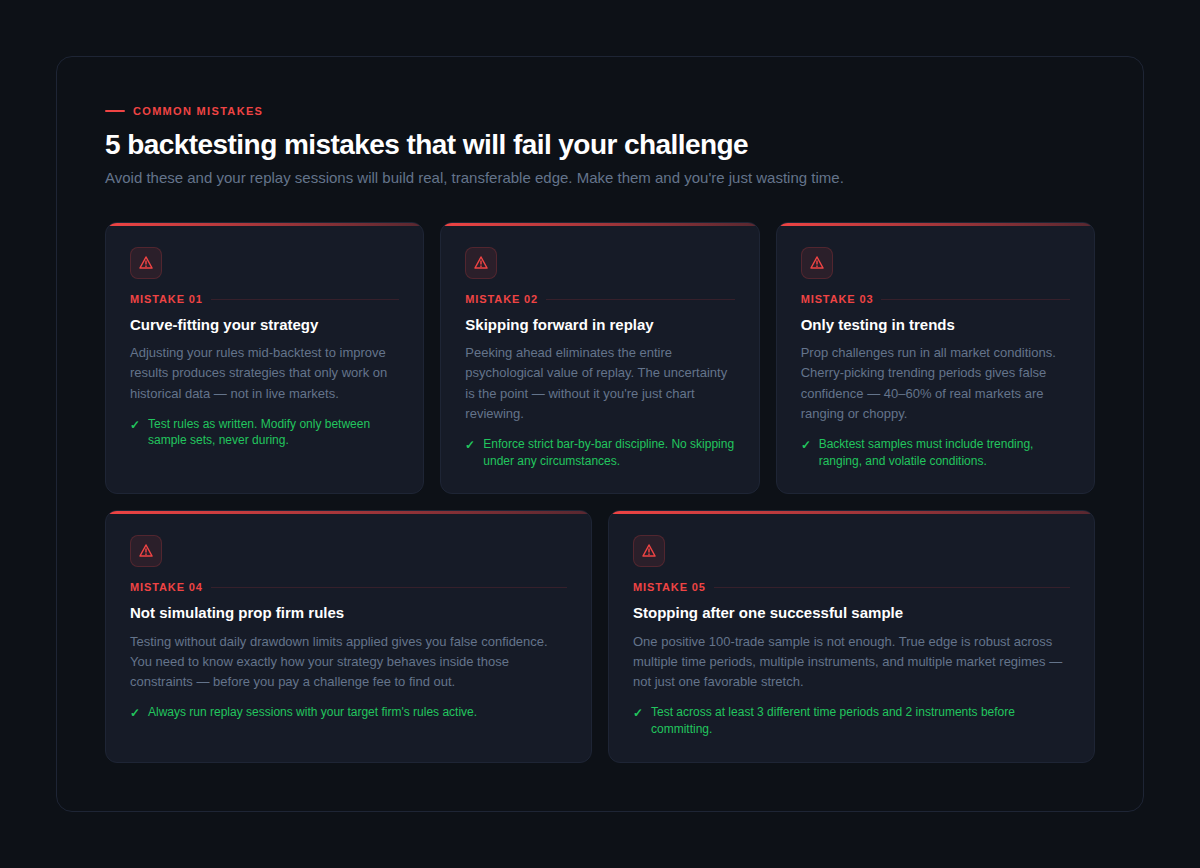
1. Curve-fitting your strategy
Adjusting your rules mid-backtest to make the results look better is curve-fitting and it produces strategies that only work on historical data. Test your rules as written, and only modify them between sample sets, not during.
2. Skipping forward in replay
The psychological value of market replay is the uncertainty. The moment you skip forward to see if a setup works before placing the trade, you've eliminated the entire point. Keep it real.
3. Only backtesting in trending markets
Prop firm challenges run during all market conditions. Make sure your backtest sample includes choppy, ranging, and trending conditions. A strategy that only works in trending markets will fail in 40–60% of real-world conditions.
4. Not simulating prop firm rules
Testing your strategy without the drawdown limits applied gives you false confidence. Always run your replay sessions with your target firm's rules active, you need to know how your strategy behaves inside those constraints before you pay a challenge fee to find out.
5. Stopping after one successful sample
One 100-trade sample that shows positive expectancy isn't enough. Test across multiple time periods, multiple instruments, and multiple market regimes. True edge is robust across conditions, not just one favorable stretch. Build a daily routine for funded trader consistency to make sure that edge carries into live trading.
See our guide on turning journal data into actionable insights for how to build a multi-sample testing process.
Couldn't find your question here?
Go check out our Help Center below!
A minimum of 100 trades is needed before drawing any meaningful conclusions. Ideally, test 200–300 trades across multiple market conditions and time periods. Small sample sizes produce unreliable statistics that can give false confidence going into a challenge.
Market replay is a form of backtesting, but a more advanced one. Standard backtesting involves scrolling through historical charts and marking setups. Market replay simulates the market in real time, bar by bar, replicating the psychological pressure of live trading, which is what makes it the preferred method for prop firm preparation.
No. Backtesting doesn't guarantee anything, but it dramatically improves your odds. It validates your strategy's edge, reveals behavioral patterns under pressure, and builds the discipline needed to execute consistently inside prop firm rules. Traders with documented, backtested strategies pass challenges at significantly higher rates.
FX Replay is purpose-built for this use case. It offers tick-accurate market replay, built-in journaling, and the ability to configure challenge parameters including daily drawdown limits and profit targets, making every session feel like a real challenge attempt.
Backtesting should be an ongoing process, not a one-time event. Before a new challenge: complete at least one full 100-trade sample. During a funded account: backtest any proposed rule changes before implementing them live. After a drawdown period: backtest the specific conditions that caused losses to understand whether the issue was the strategy or your execution.
.png)