


 Sign in


 FXR BattlesPricing
.png)
Most traders do not fail because they lack intelligence or motivation. They fail because they try to learn while capital is on the line.
Live markets are an unforgiving teacher. Every mistake has a cost, and every emotional lapse is reinforced by either pain or short-term reward. For most traders, this means blowing accounts long before they ever understand whether their strategy actually has real edge.
In 2026, trading simulators have become standard tools for serious traders—not as paper trading toys, but as structured learning environments. Modern platforms replicate real market behavior, enforce realistic execution, and allow strategies to be tested across meaningful historical samples without risking capital. They compress years of market experience into focused, repeatable training.
For traders who approach the market as a skill rather than a gamble, using a trading simulator is now a foundational requirement.
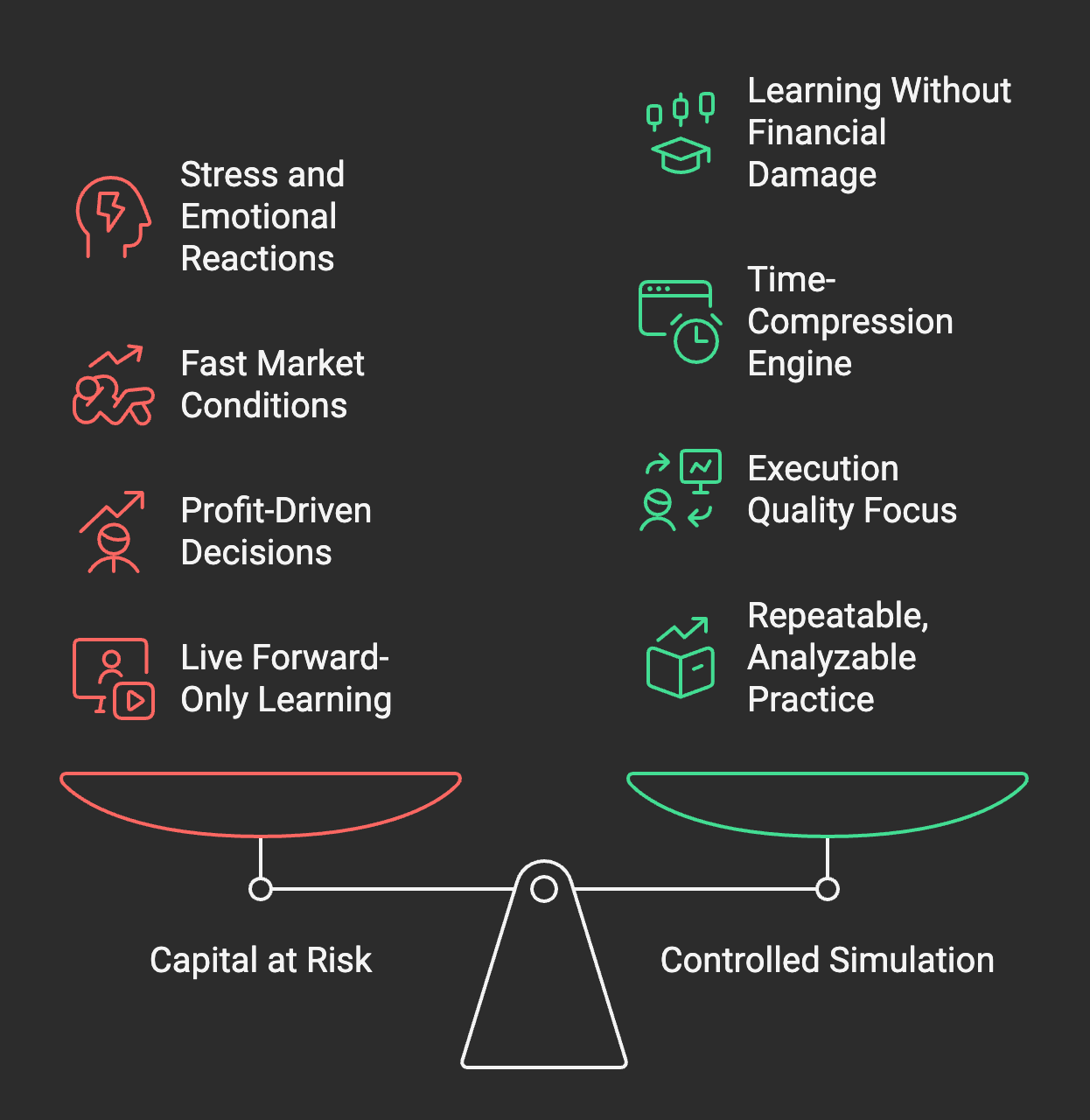
Risk-free practice does not mean avoiding losses or skipping hard lessons. It means isolating learning from financial damage. Skill development and capital exposure should not happen at the same time.
A well-designed simulator still exposes you to losing streaks, drawdowns, missed opportunities, overtrading, and poor decision making. What it removes is the financial risk that prevents objective learning. You still feel the consequences but are simply not crippled by them.
When money is removed from the equation, attention shifts from outcomes to execution. Decisions can be reviewed without emotional noise. Scenarios can be repeated until behavioral patterns and strategic flaws become obvious.
This is why properly understanding what a trading simulator is and why it matters is critical before risking capital.
Markets are faster and more complex than ever. Access is easier, but competition is relentless. Traders now operate in environments defined by tighter execution windows, algorithm-driven volatility, and nonstop information flow.
Learning directly in live markets has become increasingly expensive, not just financially, but psychologically. A trading simulator offers one advantage live trading cannot provide during the learning phase: “time compression.”
Instead of waiting months or years to experience different market conditions, traders can practice across trending, range-bound, high-volatility, and low-liquidity environments in days.
This accelerates pattern recognition and shortens the feedback loop between decision and result. With consistent simulator practice, traders build familiarity far faster, one of the core reasons many professionals emphasize the long-term benefits of using a trading simulator every day.
Trading is a performance skill. Like any discipline built on execution, progress comes from repetition under controlled conditions.
Simulators allow traders to execute hundreds of trades without fear of capital damage. This removes hesitation, encourages experimentation, and makes it possible to reach the volume of practice consistency actually requires.
Most traders underestimate how much repetition is needed to build execution confidence. Simulation removes the financial friction that blocks that process.
Modern simulators use real historical market data. This means traders experience actual volatility patterns, real market structure shifts, and authentic drawdowns.
This matters because unrealistic practice creates false confidence. Strategies that appear stable in simplified environments often break down under real volatility and structure shifts.
Platforms built for realism such as FX Replay, allow traders to see how their approach holds up when conditions become unpredictable, a key reason many professionals point to FX Replay as the most realistic trading simulators available.
One of the most damaging states for a trader is uncertainty.
Many traders go live without knowing whether their strategy has a real edge. A simulator allows traders to answer essential questions with data: win rate, expectancy, drawdown depth, and performance consistency across market conditions.
Instead of guessing, traders can systematically backtest and forward-test their ideas inside a trading simulator, turning assumptions into measurable results.
Demo accounts and simulators are often confused, but they serve very different purposes.
While demo accounts mirror live markets in real time, the difference between trading simulators and demo accounts lies in how traders actually learn. Simulators allow markets to be replayed, scenarios to be repeated, and experience to be compressed in ways live demos simply can’t replicate.
Demo accounts help traders become familiar with execution.
Simulators develop decision-making skill.

Not all simulators are built for serious development. A high-quality simulator should:
Free trading simulators can be valuable for learning day trading basics, especially when it comes to understanding platform mechanics and execution workflows. They help traders get oriented without immediate financial pressure.
However, serious development requires fewer constraints and deeper review capabilities. Paid platforms and subscriptions are all about removing limitations that interrupt deliberate practice and slow improvement.
Most traders misuse simulators by approaching them casually. If simulated behavior does not reflect intended live execution, the results are irrelevant.
The first step is using a realistic account size. Exaggerated balances distort risk perception and decision-making.
Next, define clear rules before trading:
Random trading produces random outcomes, even in simulation. Discipline in simulation matters as much as discipline in live markets. Ignoring rules only reinforces bad habits that carry forward. A structured simulator workflow, covering preparation, execution, and review is essential for turning practice into measurable progress.
Execution alone does not build skill. Review is what converts action into improvement.
After each session, trades should be reviewed objectively:
Over time, patterns emerge. Certain setups outperform. Certain mistakes repeat under pressure.
Journaling plays a key role here. Integrating trade journaling directly into the simulator workflow allows traders to connect execution, context, and reflection in one place—turning isolated trades into actionable insights.
Simulators are powerful behavior-correction tools. They allow traders to identify overtrading, hesitation, revenge trading, or rule-breaking patterns without financial damage.
Through deliberate repetition and structured review, traders can use simulation to correct bad trading habits before those behaviors reach live markets.
This is one of the most underappreciated benefits of simulation.
Simulation is especially valuable when preparing for evaluation-based environments. Practicing under defined rules, drawdown limits, and consistency requirements helps traders adapt to real constraints before real capital is at risk.
For this reason, many traders use simulators to prepare for prop firm evaluations, allowing them to pressure-test their process and risk management long before entering a funded environment.
The move from simulation to live trading should be gradual and data-driven.
A trader is ready to transition when:
A single good week is irrelevant. Consistency over time is what matters.
Even after going live, simulators remain valuable. Professional traders continue to use them to test new ideas, adapt to changing conditions, and rebuild confidence after drawdowns. Simulation becomes a development lab, not a beginner crutch.
One of the most common mistakes is treating simulation like a game. Overtrading, ignoring losses, and chasing unrealistic returns all undermine the value of practice.
Another mistake is over optimizing strategies. A simulator can make any approach look perfect if enough parameters are adjusted. This often leads to fragile strategies that fail in live markets.
Many traders confuse simulated success with guaranteed live performance. A simulator reveals potential. It does not remove uncertainty. The goal is preparation, not prediction.
Practicing without risk is not about avoiding failure. It is about earning confidence before capital is exposed.
The fastest way to improve as a trader is not by placing more live trades, but by compressing experience and tightening feedback. Replay-driven simulation makes this possible. Traders can revisit real market conditions, make real decisions, and review those decisions with clarity, without paying tuition to the market.
In 2026, learning to trade without structured simulation is not bold, but inefficient. Serious traders separate development from exposure. They prove their edge, understand their drawdowns, and refine execution before risking capital.
Couldn't find your question here?
Go check out our Help Center below!
A demo account mirrors live markets in real time. A simulator allows traders to replay historical markets, compress experience, and practice specific scenarios repeatedly. One familiarizes execution; the other develops skill.
Yes, if the practice environment is realistic and structured. Simulators expose traders to real market behavior, drawdowns, and decision pressure without causing financial damage during the learning phase.
There is no fixed timeline. Traders should transition only after achieving consistent results over a meaningful sample size, understanding drawdowns, and demonstrating rule adherence, even during losing streaks.
Absolutely. Experienced traders use simulators to test new ideas, adapt to changing market conditions, and rebuild confidence after drawdowns without risking capital.
Decision quality, execution consistency, and rule adherence. The goal is reducing errors and improving repeatability.
.png)
.png)