


 Sign in


 FXR BattlesPricing
.png)
Trading will either make you or break you. There’s rarely a middle ground.
The difference isn’t talent, or even your strategy; it’s simply whether you learn from your mistakes or keep making the same ones with more money on the line.
Here’s the reality: the majority of the traders don’t journal at all.
In a profession like trading, where feedback is everything, this absence of reflection is detrimental. Without a journal, you are trading, but you are not truly learning or improving. Understanding what your journal data is really telling you is where real improvement begins.
Even traders who do journal often get it wrong. They log numbers, focusing on data points rather than extracting genuine insights, which transforms their biggest advantage into yet another blind spot.
Consistent tracking is the key to identifying and overcoming obstacles in your performance.
Here’s where most trading journals fail, and what actually works instead.
Recording just the trades that went well is like reviewing only the test scores that came back clean. Comforting, but useless for improvement.
Most traders avoid logging losses out of discomfort. The result is a journal that feels good to maintain and produces no real insight.

The painful losses contain the most actionable insights. Every skipped entry is a pattern that gets to repeat itself.
Pro Tip: Make it a rule to log the trade immediately after it closes, win or lose. Resistance to logging a losing trade is useful information on its own. Note it.
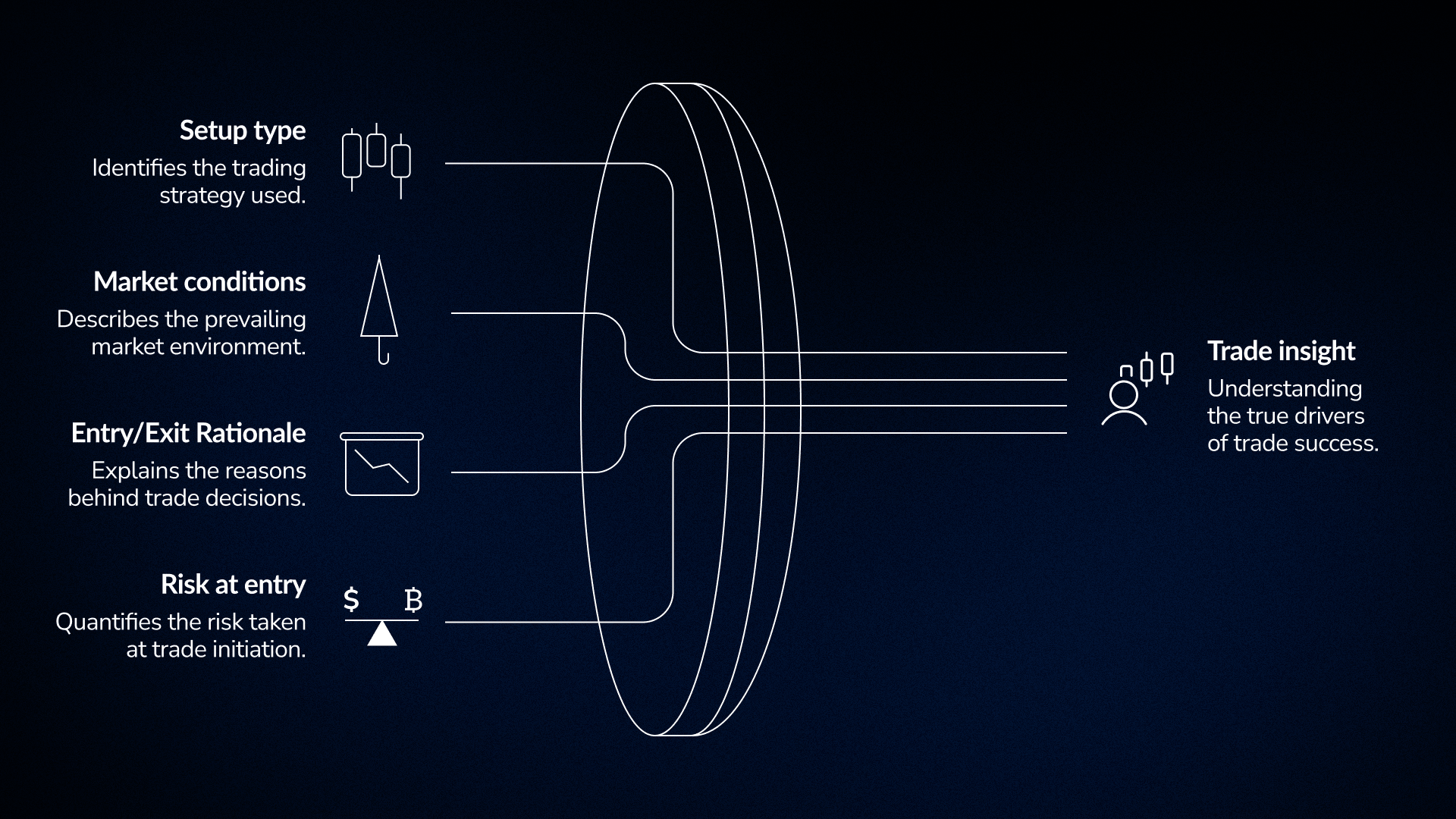
A trade’s profit and loss number is the outcome, not the reason.
Most beginners, and plenty of experienced traders, just note a number: “+$300. It doesn't explain why the trade worked, whether the process was sound, or whether the result is repeatable.
Context fields that turn outcomes into insight:
Without these fields, a trader can run the same journal for years and still not understand what actually drives their results.
In FX Replay, every trade placed during a replay session sits attached to the exact chart it was taken on. When reviewing a session, the journal entry and the price action live in the same place. A trader sees not just what they wrote but what the market was doing at that moment, which is where the real reason for a decision becomes clear rather than a reconstructed memory.
Pro Tip: Write the trade rationale before closing the position, not after. Post-outcome memory is unreliable. Pre-close notes capture the actual thinking, not the justified version.
A journal updated twice a day every day is more valuable than a detailed journal completed once a week.
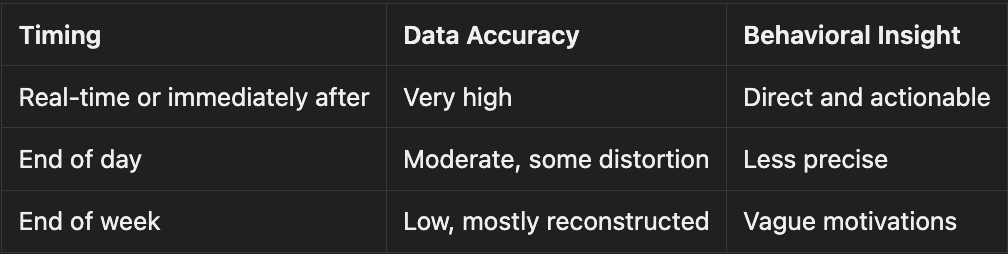
Memory research indicates that recall drastically declines within the initial hour after an event. If you delay journaling, your notes will be reconstructed, not honest records. Selective memory begins editing the trade log before it's even written down.
What logging timing actually produces:
The majority of traders who start journaling quit within a few weeks, usually because the process is too elaborate to sustain. The fix is simplicity, not more detail. A lean journal completed every day consistently outperforms a comprehensive one filled out sporadically.
Pro Tip: Set a hard rule: no new session starts until the previous one is logged. This will help in building a consistent journaling habit.
Market data is objective. The decisions made while reading it are not.
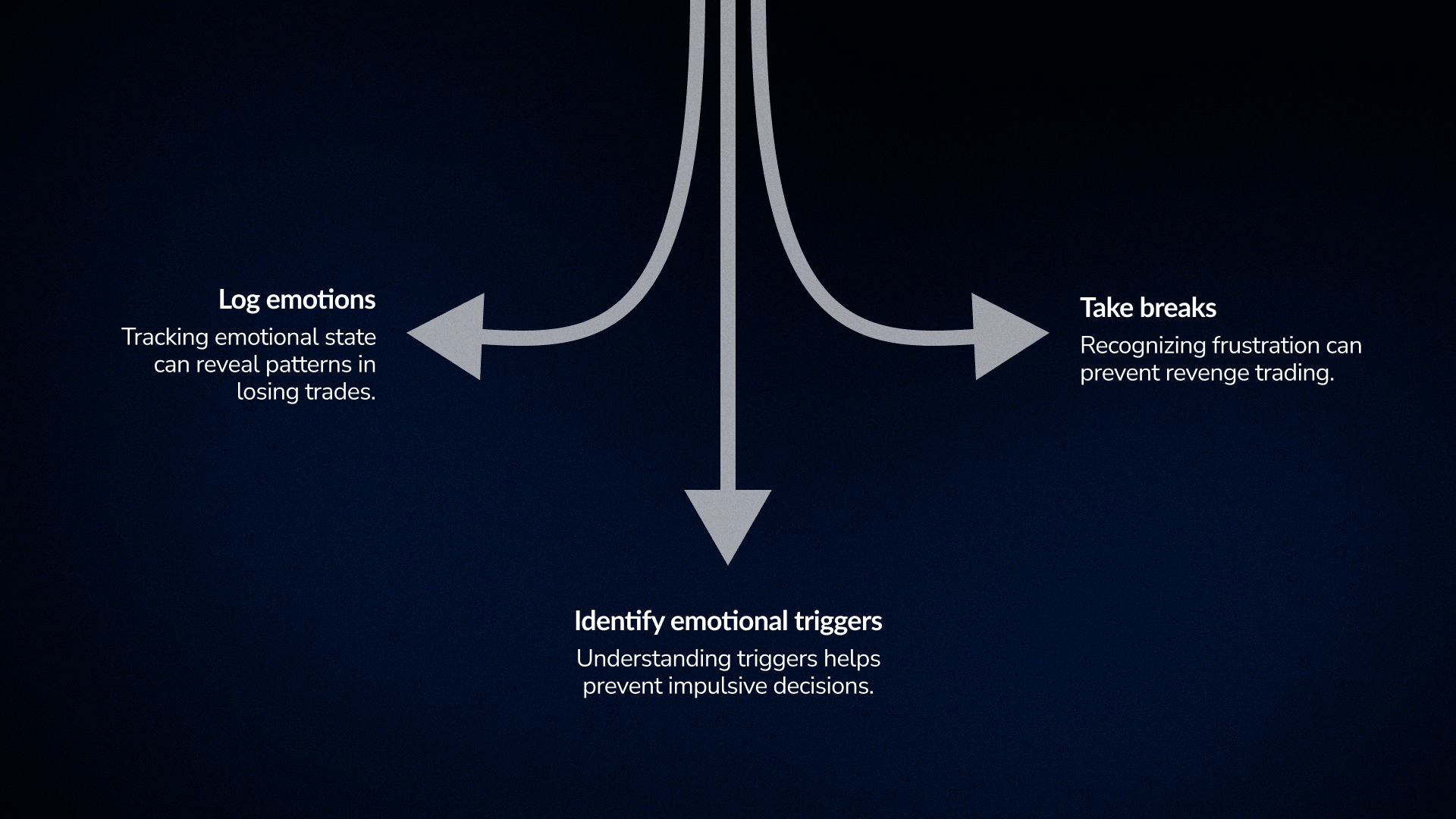
Traders who track emotional state consistently find that their worst losing trades cluster around specific psychological conditions, not specific setups. FOMO before a news event, overconfidence after a winning streak, frustration following a stopout that leads directly into a revenge trade, etc.
What to log:
Pro Tip: If "frustrated" appears as the emotional state more than twice in a single session, that session is probably done regardless of what the chart looks like. Log it, close the platform, come back fresh.
Keeping a journal produces data. Analyzing that data leads to improvement. These are distinct activities, and most traders only engage in the former. Journals that go unreviewed are merely costly diaries.
The real value of a journal appears during review, when patterns across trades become visible that no single entry could reveal.
An effective review cadence:
The most expensive trading mistake is repeating one that five minutes of honest review would have caught. Learn the journaling routine that builds consistency and prevents those repeating mistakes.
FX Replay's tag analysis lets traders filter the entire trade history by any tag applied during journaling, including behavioral tags, setup types, and session conditions. The result is a performance breakdown by category that surfaces what's working and what's quietly draining the account.
Pro Tip: At the end of each week, pull up only the red-flagged trades, the rule violations, the emotional entries, the revenge trades. Give those 15 minutes of serious attention before looking at anything else.
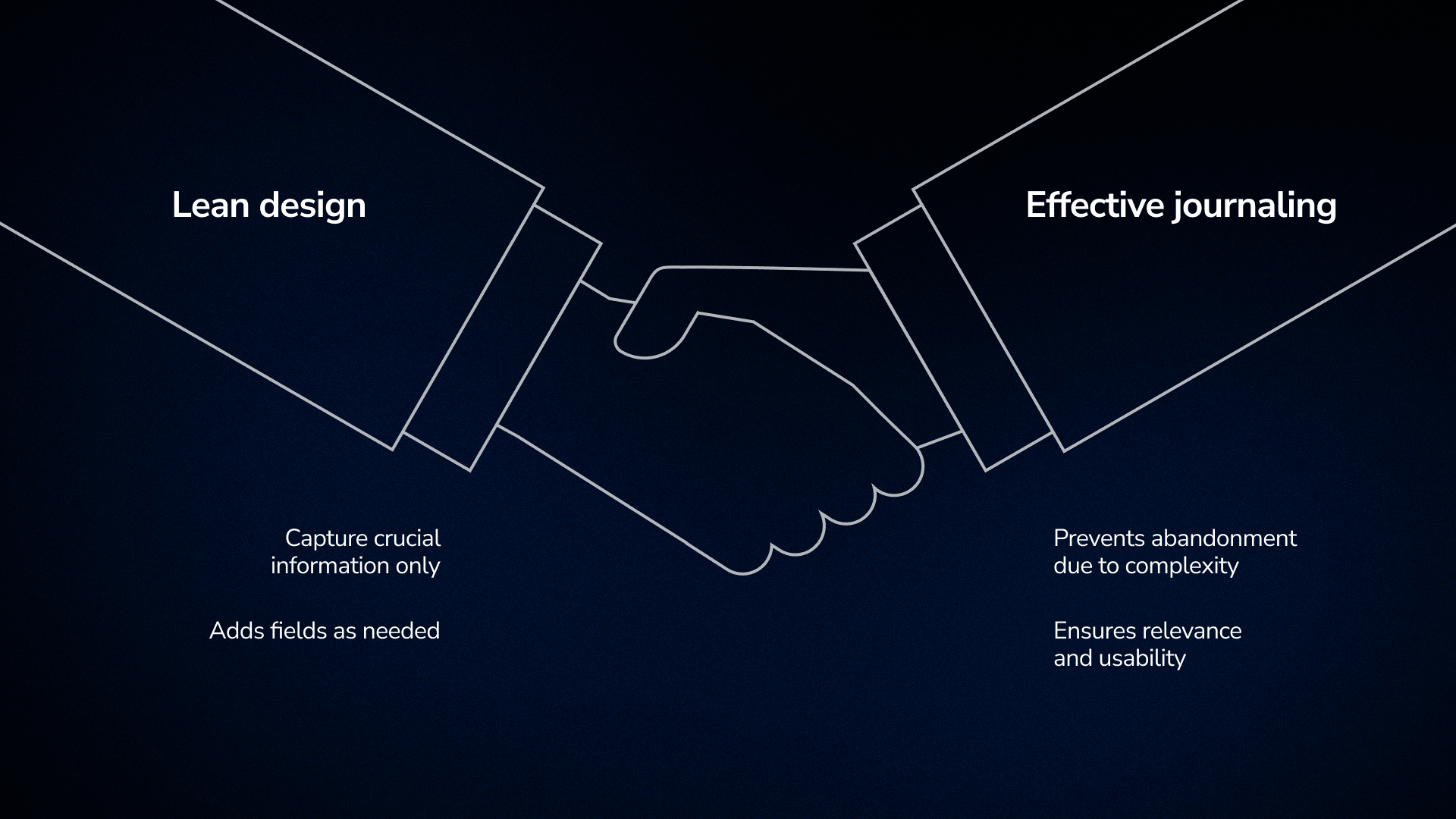
Perfectionism in journal design is one of the fastest ways to stop journaling entirely. A 20-field journal gets abandoned in two weeks.
The most effective journals use a lean structure. Enough fields to catch what matters, not so many that the process feels like tax preparation after every session.
Essential fields only:
Pro Tip: Start with five fields for one month. Add a field only when the current fields consistently surface a question they can't answer. Journals built incrementally get used often.
Saving a chart screenshot at entry, and optionally at exit, preserves the visual context that makes trade review meaningful. Without it, a journal entry says "breakout entry, momentum setup" and the review session tries to reconstruct what the market actually looked like from memory.
Screenshots capture trade location within the trend, the specific candle formation at entry, the structure that made the setup valid (or invalidated it in hindsight).
FX Replay attaches screenshots directly to journal entries inside the session, so reviewing a trade means seeing the exact chart moment alongside the notes. The decision and its context sit in the same place.
Grouping all trades together often masks the true performance of individual strategies. While the overall win rate might seem acceptable, a deeper dive reveals that some trade setups offer a significant advantage, while others are entirely lacking one.
Clearly categorizing trades by setup type is essential to highlight this difference.
Let’s look at this sample data on EURUSD
The combined win rate is about 50%, which appears mediocre.
However, a deeper analysis reveals two distinct trading patterns: one setup with high potential for scaling (morning breakouts) and another that should be eliminated (afternoon reversals).
Without setup categorization, the losing setup gets carried by the winning one until the pattern becomes obvious through damage rather than data.
Pro Tip: Start with three to five consistent setup names and apply them to every trade for a month before adding more. The cleaner the categorization, the more reliable the analytics that follow.
A journal that only records whether a trade made or lost money misses the most important variable: whether the risk taken was appropriate to the setup.
Consistent risk mistakes hide in the detail. "Stopped out, down $180" doesn't reveal whether the position was oversized, whether the stop was too close, or whether the risk-to-reward ratio justified the entry at all.
Track per trade:
Over enough trades, the journal surfaces which setups and emotional states consistently push sizing higher than the rules allow. Most account drawdowns trace back to a small number of oversized positions taken at high-emotion moments. The data to prevent the next one is already there; it just needs to be captured.
Pro Tip: Log planned risk and actual risk as separate fields. When they differ, it's almost always an emotional entry. Tracking the gap between the two is one of the fastest ways to identify where risk management actually breaks down.
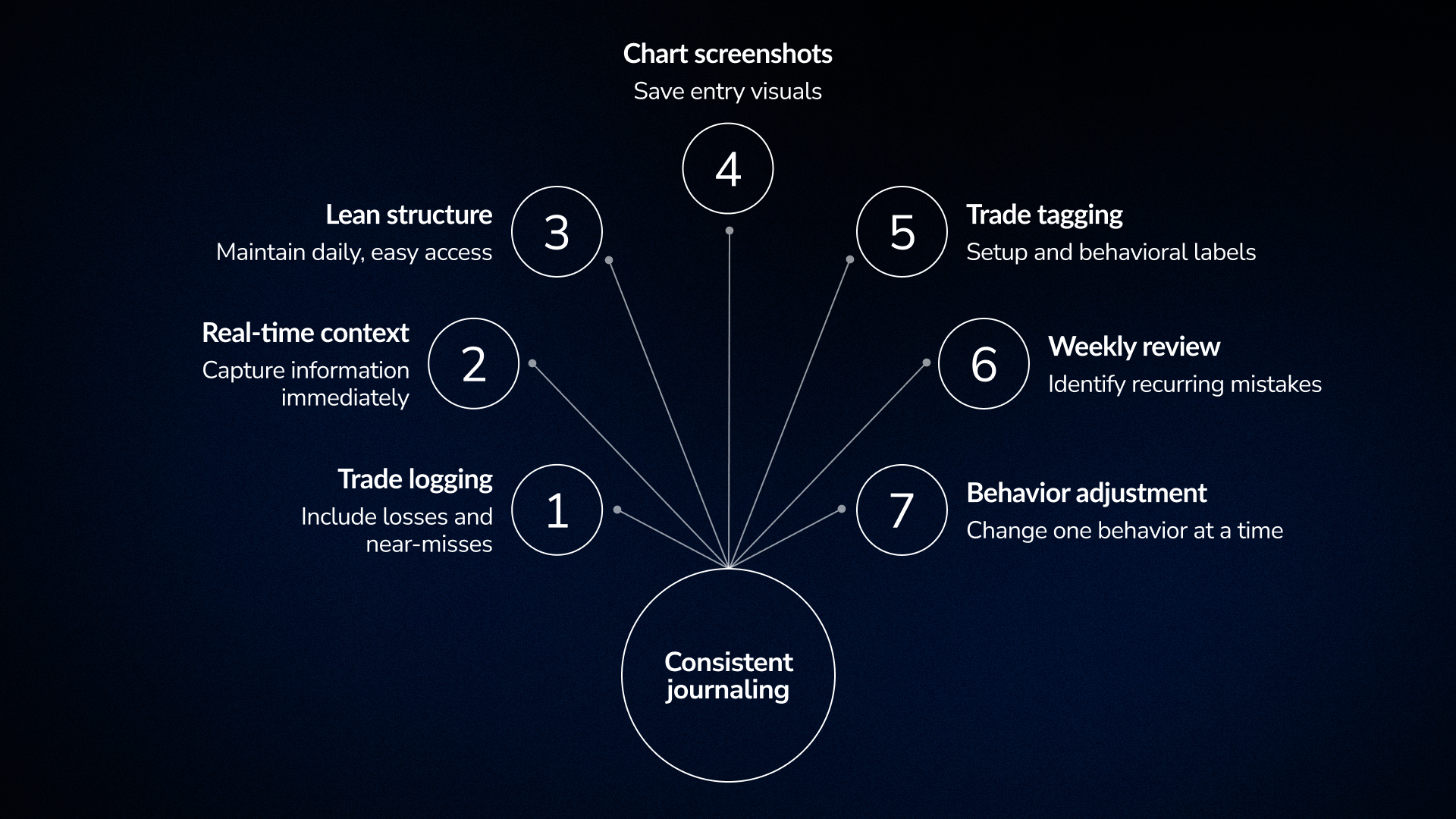
Successful traders who benefit from journaling follow specific habits. These practices are straightforward, demanding consistency more than intense effort.
The traders who don't improve usually journal inconsistently, review rarely, and treat the journal as a record of what happened rather than a diagnostic tool for what keeps happening.
Pro Tip: The perfect journal is the one you’ll actually keep using in six months, not the one with the most bells and whistles.
These walkthroughs from the FX Replay YouTube channel show how structured journaling, tag analysis, and replay work together in practice:
Start structured trade logging in FX Replay today.
Couldn't find your question here?
Go check out our Help Center below!
Losses contain the most actionable data. A journal built only on wins produces overconfidence and leaves blind spots untouched.
Setup type, entry rationale, emotional state, and outcome. Everything else is useful but secondary to those four.
Post-session for flagging deviations, weekly for pattern identification, monthly for measuring whether anything actually changed.
The setups or sessions that produce the most resistance to honest logging are usually the ones driving the most damage to the account.
A spreadsheet works if used consistently. The advantage of reviewing trades inside FX Replay is that the journal entry and the chart it came from exist in the same place, which removes the reconstruction problem that makes spreadsheet reviews less reliable.
.png)
.png)