


 Sign in


 FXR BattlesPricing
.png)
Every prop firm evaluation has one goal: to filter out gamblers and retain consistent, process-driven traders. The fastest way to prove you belong in the second group is to arrive at your challenge with a strategy backed by hundreds, ideally thousands, of historical trades.
Backtesting is not just about finding edge. It is about internalizing edge. When you have replayed your setup across three years of EUR/USD price action, you stop second-guessing entries during drawdowns. You already know how deep the drawdown gets before it recovers. That psychological certainty is what separates funded traders from those who blow challenges on week two. Learning how to structure your backtesting for prop firm challenges is the starting point.
"You can't follow rules you haven't practiced. Backtesting is practice; it builds the muscle memory to execute under pressure."
Without data, you are guessing. With data, you are executing. FX Replay gives you the infrastructure to turn guessing into a documented, repeatable process.
FX Replay is a professional-grade forex market replay and backtesting platform that lets you fast-forward through historical price data tick-by-tick, execute trades in a simulated environment, and collect granular statistics on every aspect of your performance.
Unlike simply scrolling left on TradingView, FX Replay replicates the real experience of being in a trade, you can't peek at what happens after the close of the current bar. This forces genuine decision-making and makes your backtesting results far more representative of live performance.
Pro Tip: Use FX Replay's multi-timeframe view to confirm higher-timeframe confluence before executing in your replay session. This mirrors exactly how you'd trade live, making your data far more realistic.
Before you open FX Replay, you need a strategy with clearly defined, rule-based criteria. Vague strategies produce vague data. Here is a simple framework to build a backtest-ready setup:
Decide whether you trade with the higher-timeframe trend, counter-trend, or only in ranges. Document the exact criteria e.g., "I only take longs when the Daily chart shows a higher high and higher low sequence."
This is your specific signal: a candlestick pattern, a break and retest of a key level, an indicator cross, or an order block tap. One trigger, not five. The fewer variables, the cleaner your data.
Structure-based stops (below a swing low, above a swing high) produce better data than fixed-pip stops. Know exactly where your stop goes before each trade.
Most prop firms require a 1:1 or better average RR. Aim for setups that naturally offer at least 1.5R. Document your take-profit logic (next structure level, fixed RR, partial closes).
"IF the Daily is bullish, AND price returns to the 4H demand zone, AND there is a bullish engulfing on the 1H, THEN enter long at close with SL below zone." This is what you will test.
Now that you have a defined strategy, here is how to backtest it properly in FX Replay:
Go back at least 2–3 years on your primary timeframe. Speed through the data at 100–500× and mark every instance where your setup criteria are met. Do not execute yet, just flag the setups. This phase reveals how frequently your setup appears (its "frequency") and helps you spot edge cases in your rules.
Now replay at a realistic speed (2–10×) and execute each flagged trade. Let FX Replay's simulated order engine handle your SL and TP hits. Record your reasoning in the journal, what made this a valid setup, and if you hesitated, why.
Review your stats from Phase 2. Is your win rate dragged down by a particular session (e.g., Asian session chop)? Are your losers all in low-volume environments? Adjust one rule at a time and run another 100 trades to see if the metric improves. This is not curve-fitting, it is eliminating conditions where your edge does not exist.
Best Practice: Keep a "Did Not Take" (DNT) log in FX Replay's notes. When you see a setup that almost qualifies but doesn't, record why you passed. This prevents retroactive rule-bending and keeps your backtest statistically honest.
Prop firms are running a business. They fund traders who are unlikely to blow their capital. When you study your FX Replay statistics, focus on the metrics that map directly to prop firm risk rules:
Not all prop firms are equal, and not all are compatible with every trading style. Here is a quick comparison of how to match your strategy to the right firm:

Once you know your target firm's rules (profit target, drawdown limits, minimum trading days, news/weekend restrictions), replay those specific conditions in FX Replay. Simulate the evaluation period: if the challenge is 30 days with a 10% profit target, replay 30 trading days of history using only your defined setup and verify you would have passed.
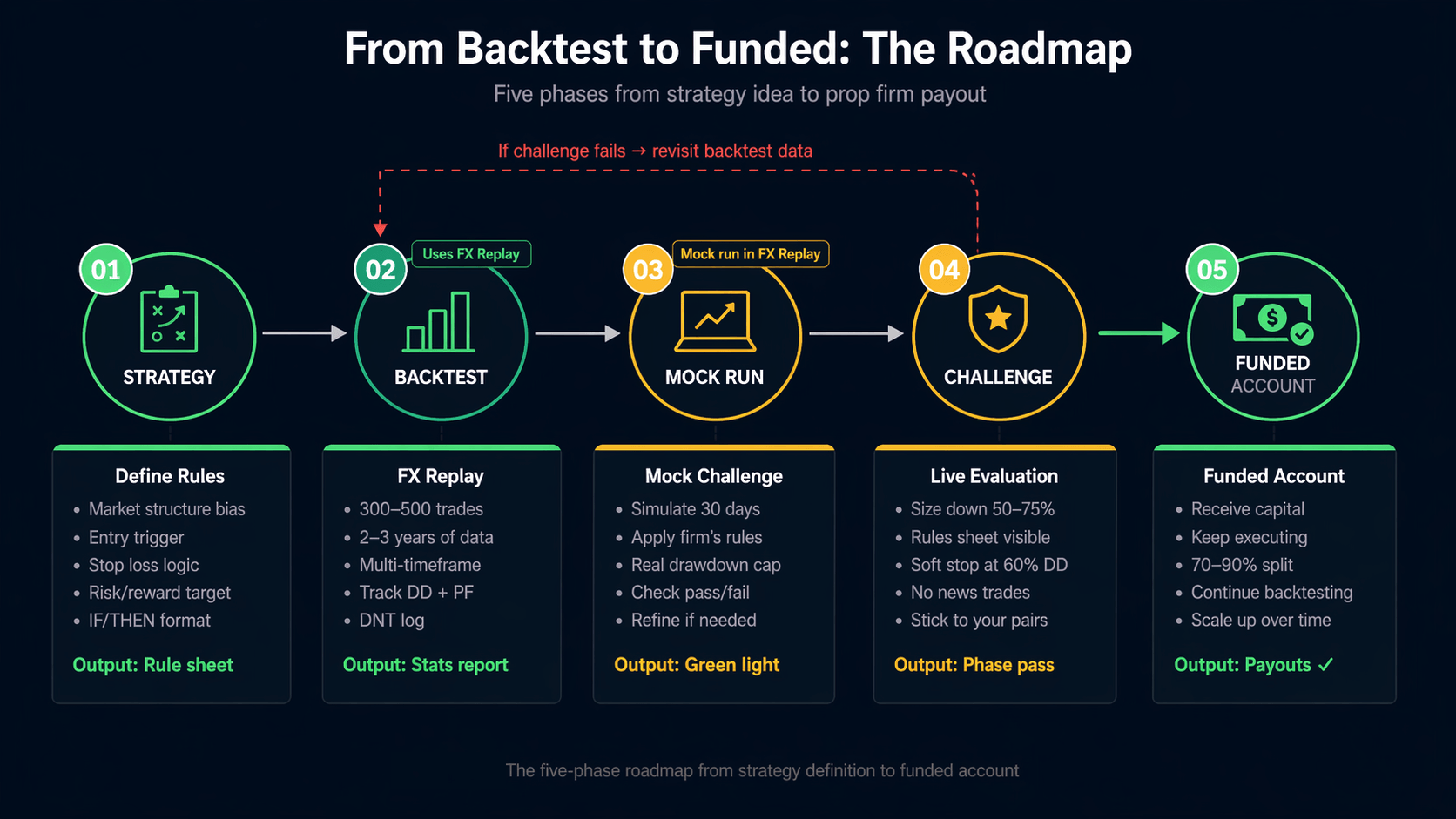
The moment of truth is moving from replay data to a real evaluation account. Here is how to make that transition without losing your edge:
Before purchasing any evaluation, run a 30-day mock challenge in FX Replay. Set a starting balance, apply the firm's exact drawdown rules, and trade only your validated setup. If you pass the simulation with comfortable margin, you are ready. If you breach the drawdown, you have saved yourself the entry fee and gained valuable data.
A step-by-step prop firm preparation guide will help you avoid the most common transition mistakes.
Regardless of your backtest results, trade at 50–75% of your intended position size for the first five to ten live trades. Real money, even at simulated challenge scale, triggers psychological responses that replay does not. Give yourself a buffer while your emotions calibrate.
Write your IF/THEN rules on paper and place them next to your monitor. When the market moves fast and FOMO hits, the physical reminder forces a conscious checklist before entry.
"The trader who passes is not the one with the best strategy. It is the one who executes their strategy with the most fidelity."
Understanding what causes failure is just as important as knowing the path to success. These are the most common pitfalls — all of which FX Replay's data can help you avoid:
High-impact news (NFP, FOMC, CPI) can spike the spread and trigger stops without price "legitimately" hitting your level. In your FX Replay sessions, use the economic calendar overlay to identify how your strategy performed around news. If it consistently blows up around CPI, add a "no trade within 30 minutes of high-impact news" rule.
The profit target is not a deadline, it is a ceiling. Many traders blow their daily drawdown in week one by risking 3–4% per trade to "get ahead." Your backtest shows your natural monthly expectancy at 1% risk. Trust it. Compounding 1% risk trades to 10% profit takes roughly 10–14 winning trades, well within a standard 30-day challenge.
You backtest GBP/JPY for 300 trades, then switch to EUR/USD during your challenge because "it looks cleaner today." Different pairs have different spread behavior, volatility profiles, and false-breakout tendencies. Stick to the pairs you have actually replayed. FX Replay supports 50+ instruments, backtest the pair you intend to trade.
When you are at 7% drawdown in a 10% max-DD challenge, you do not have 3% left — you effectively have 1–2% because one bad trade can end the challenge. Build a personal "soft stop" rule in your plan: if you hit 60% of the maximum drawdown, stop trading for the day and reassess.
Most traders fail prop firm challenges for one reason: they don’t trust their own system. Backtesting fixes that by replacing emotion with evidence and turning hesitation into execution.
When you know your numbers, you stop reacting to every loss. Instead, you follow the plan because you have already proven it works. That is the difference between blowing accounts and getting funded.
Start backtesting in FX Replay and leverage our prop firm simulator to test your system, and build confidence in your strategy, before taking your next prop firm challenge.
Couldn't find your question here?
Go check out our Help Center below!
No tool or method can guarantee a pass. Markets evolve, and past performance is not a guarantee of future results. However, thorough backtesting dramatically improves your probability of success by (a) confirming your edge exists, (b) showing you the realistic drawdown profile of your strategy, and (c) building the psychological familiarity needed to execute under pressure. Traders with 300+ documented trades and a profitable backtest are in a fundamentally different position than those who attempt challenges on intuition alone.
Yes. FX Replay provides tick-level historical data for major, minor, and exotic forex pairs, as well as indices, commodities, and some crypto assets. Data typically goes back several years, providing ample history for statistically meaningful backtesting across different market regimes: trending, ranging, high volatility, and low volatility periods.
Run two separate mock challenges in FX Replay, each with the exact rules of Phase 1 and Phase 2 of your target firm. Phase 1 typically has a higher profit target (e.g., 10%) and slightly relaxed drawdown rules. Phase 2 usually has a lower target (e.g., 5%) and tighter scrutiny on consistency. By simulating both phases back-to-back with real historical data, you will identify whether your strategy fits both stages before spending a penny on a real evaluation.
A profit factor (gross profit ÷ gross loss) of 1.5 or above is a solid benchmark. Anything below 1.2 suggests your edge is marginal and may not survive the additional stress of a live evaluation. If your FX Replay backtest shows a profit factor between 1.2 and 1.5, focus on reducing losing trade sizes through tighter stop-loss placement or filtering out lower-probability setups before moving to a live challenge.
.png)
.png)