JJ Simon’s Fair Value Theory Strategy

NQ 1-minute scalping strategy using fair value, BOS/MSB, displacement candles, and ATR-based risk management.

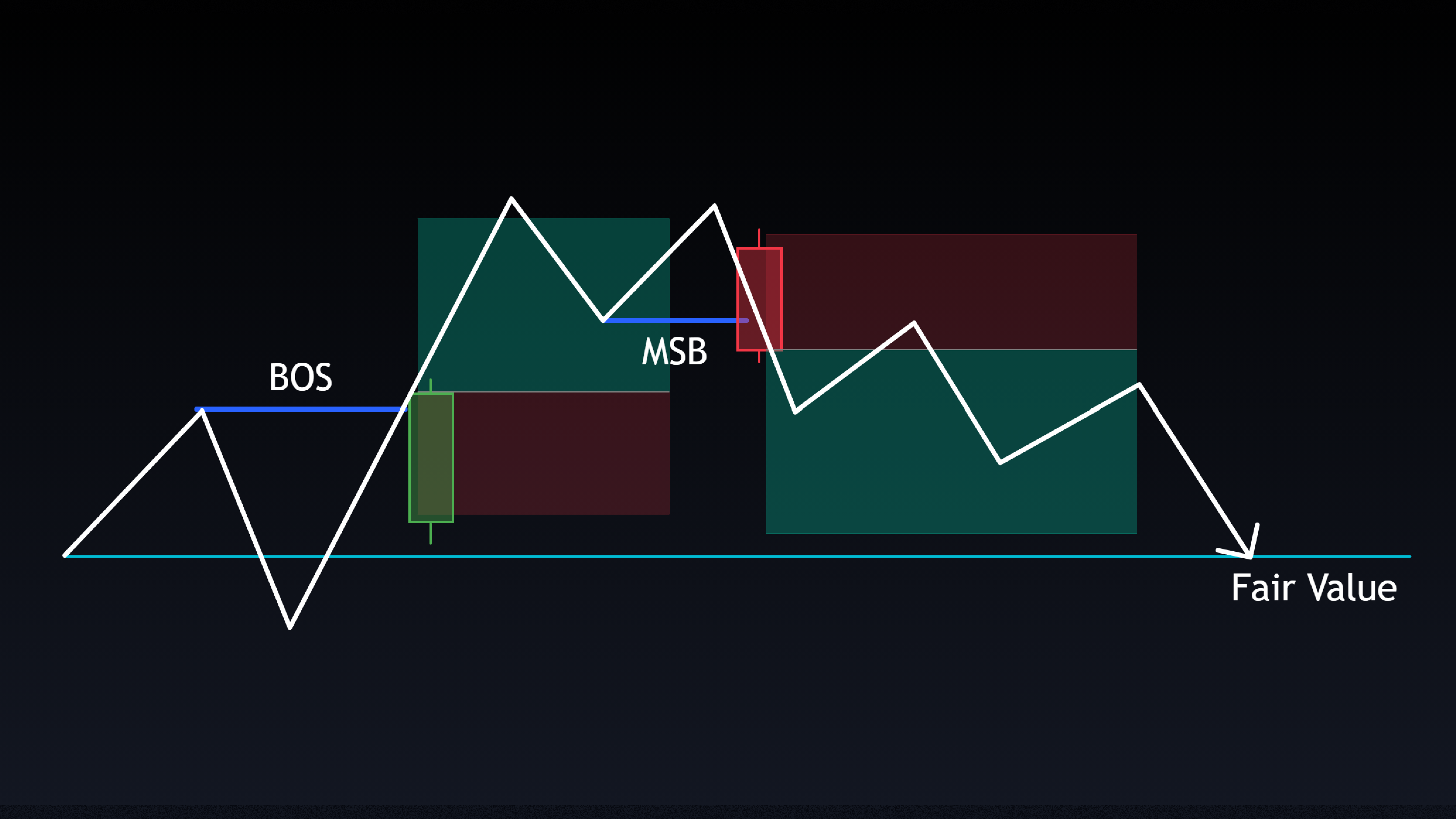
JJ Simon’s Fair Value Theory is built on a straightforward market premise: when no new information is available for the market to price in, price is likely to revert toward a reference point known as “fair value.” For the NQ, Nasdaq-100 futures, JJ has identified two price levels that consistently act as fair value: the 9:30 AM market open price and the 2:00 PM NY afternoon price. The strategy is traded exclusively on the 1-minute chart during two New York sessions: 9:30-11:00 AM and 2:00-3:00 PM.

Each trade window follows a two-phase approach. In the first 10-15 minutes, traders look for continuation moves, with price pushing away from fair value with momentum. For the remainder of the window, the focus shifts to mean-reversion setups, with price returning back toward the fair value reference level. All entries require the same two-condition trigger: a Market Structure Break, MSB, or Break of Structure, BOS, confirmed by a strong displacement candle. Once entered, trades target a fixed 1.5R with no active trade management.

How the strategy works

Entry setup and conditions

A valid entry requires two things to occur together: a confirmed structure break and a qualifying displacement candle. A BOS, Break of Structure, signals trend continuation, while an MSB, Market Structure Break, signals a potential trend reversal. Both can be used as entry triggers depending on the phase of the trade window.

A displacement candle must close decisively, with a counter-wick measuring less than 20% of the distance from the candle’s open to the counter-wick high or low. Use Fibonacci settings 0, 0.2, and 1 to measure this. If either condition is absent, the trade quality is reduced and the setup should be skipped.

Stop loss, take profit, and position sizing

Stop loss distance is determined by the current Average True Range, ATR, to account for changing market volatility. The take profit is always set at 1.5R, with no trade management and no partial exits. Using 1, 2, or 3 NQ contracts at the appropriate ATR tier equates to approximately $1,000 of risk per trade, with one NQ point equal to $20.

Above 20, high volatility

Stop loss: 50 points
Take profit: 75 points

7-20, normal volatility

Stop loss: 25 points
Take profit: 37.5 points

Below 7, low volatility

Stop loss: 16.5 points
Take profit: 24.75 points


Watch & Learn

Get PDF
Table of contents

Have questions?
We’ve got answers.

Couldn't find your question here?
Go check out our Help Center below!

Help center

Can this strategy be backtested on FX Replay if I'm not a futures trader?

Yes. While this strategy is built around NQ futures, the entry logic, structure breaks, displacement candles, and mean-reversion to a reference price, applies to the CFD equivalent NAS100 as well. FX Replay supports a wide range of assets including forex pairs, indices, and futures, so you can adapt and test the same framework on the markets you trade. Free accounts have access to non-premium pairs, while Pro accounts unlock the full asset library and advanced backtesting and analytics features.

Should I track continuation trades and mean-reversion trades separately?

Yes, this is recommended. The two trade types behave differently by design, and mixing them in the same data set makes it harder to identify where your edge is strongest. Using separate tags in FX Replay's journal for continuations and mean-reversions lets you run tag analysis on each independently, so you can see which phase of the trade window, and which trade type, is producing the best results for you.

What candles count for valid entries?

Look for a candle that clearly breaks structure and has less than a 20% counter-wick from the candle's open to the counter-wick high or low, measurable using Fibonacci levels set to 0, 0.2, and 1. The overall candle size relative to surrounding candles is more of a discretionary filter, it is optional and not required for a valid entry. As long as there is a clear structure break and the counter-wick rule is satisfied, the candle qualifies.

How do I get started backtesting this strategy on FX Replay?

The best way to get started is with FX Replay's 5-day free trial of the Pro plan, which gives you full access to the asset library and advanced backtesting and analytics features from day one. After signing up, you can load a session, select your instrument and date range, and start replaying price action bar by bar. The platform includes built-in trade logging, session statistics, and a journal so your results are tracked automatically as you go. Visit the Getting Started section of the FX Replay Help Center for step-by-step guides.

Matt's Wicks Strategy

By

Matt from FX Replay

Learn the essential terms—liquidity pools, FVGs, SMT, and more—to confidently execute high-quality, rules-based setups.
Intermediate
Intraday
London
New York
Forex
Ali Khan Dealing Range Theory

By

Ali Khan

This mechanical strategy uses Type 2 Dealing Ranges & SMT Divergence to frame precise intraday entries with 2R–3R targets using simple entry models.
Intermediate
Intraday
London
Forex